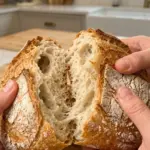
Ingredients
Scale
- 400 g bread flour (about 3⅓ cups, depending on how it is measured)
- 320 g water (320 ml), at room temperature
- 100 g active sourdough starter, at 100% hydration
- 9 g salt (about 1½ teaspoons)
- Extra flour or semolina for dusting
Important: Use a lively starter that has risen noticeably after feeding and is showing bubbles. For the best same-day results, your starter should be near its peak activity.
Equipment you will need
- Large mixing bowl
- Kitchen scale
- Dough scraper
- Baking stone or heavy baking tray
- Parchment paper
- Metal tray for steam, if your oven manufacturer permits it
- Wire cooling rack
- Oven mitts
Instructions
Follow these nine steps for an open, airy loaf. Read through them once first, and plan your day around the folds.
Step 1: Mix the dough
- In a large bowl, combine the water and active sourdough starter.
- Stir until the starter is mostly dispersed.
- Add the bread flour and mix with a spoon or wet hand until no dry flour remains.
- Cover and let the dough rest for 20-30 minutes.
- The dough will be sticky and loose. That is exactly what you want for ciabatta.
Step 2: Add the salt
- Sprinkle the salt over the dough.
- With a wet hand, pinch and fold the dough gently until the salt is incorporated.
- Cover the bowl and let it rest for another 15-20 minutes.
- Avoid adding extra flour just because the dough feels sticky. A wetter dough helps create the open crumb.
Step 3: Build strength with stretch-and-folds
Over the next 1½-2 hours, perform 4 sets of stretch-and-folds, approximately 30 minutes apart. For each set:
- Wet your hand lightly.
- Grab one edge of the dough, stretch it upward gently and fold it over the center.
- Rotate the bowl and repeat on the remaining sides.
- Cover the bowl and let the dough rest until the next set.
As the folds progress, the dough should become smoother, more elastic and better able to hold its shape. If the dough resists stretching, stop and let it rest for a few minutes rather than forcing it.
Step 4: Bulk fermentation
- After the final fold, cover the bowl and leave the dough in a comfortably warm place.
- Let it ferment until it has increased in volume by roughly 50-75%, looks bubbly around the edges and has a slightly domed, airy surface.
- This may take another 1-3 hours, depending on your starter and room temperature.
- Watch the dough rather than the clock. A strong starter and warm room may speed things up, while a cool kitchen can slow fermentation considerably.
- For an open, airy crumb, do not rush this stage, but avoid letting the dough become excessively slack and collapse.
Step 5: Prepare the work surface
- Generously dust a clean work surface with flour or a mixture of flour and semolina.
- Gently ease the dough out of the bowl without pressing out the gas.
- Dust the top lightly with flour.
- Use a dough scraper to divide the dough into two roughly equal portions.
- Do not knead the dough or aggressively reshape it. The bubbles you have built during fermentation are essential to the final texture.
Step 6: Shape the ciabatta
- Gently stretch each portion into a rustic rectangle.
- If needed, tuck the edges underneath just enough to make a loose loaf shape.
- Transfer each loaf onto a piece of parchment paper, leaving space between them.
- Cover loosely and let them rest for 20-40 minutes, until slightly puffier.
- Ciabatta is meant to look rustic. Do not worry about perfectly straight edges.
Step 7: Preheat the oven
- Preheat the oven to 240°C (465°F), ideally with a baking stone or heavy baking tray inside.
- Allow at least 30 minutes for the oven and baking surface to heat thoroughly.
- Place a separate metal tray on a lower rack if you plan to create steam.
- Steam safety: When the bread goes in, carefully add hot water to the steam tray if your oven manufacturer permits it. Keep your face and hands away from the escaping steam. Never pour water onto an oven’s glass door or directly onto a baking stone.
Step 8: Bake
- Transfer the loaves, still on parchment, onto the hot baking surface.
- Introduce steam using your oven’s safe method, then close the door promptly.
- Bake at 240°C (465°F) for 10 minutes.
- Carefully vent the steam if safe to do so, then lower the temperature to 220°C (430°F).
- Continue baking for another 10-15 minutes, until the crust is deeply golden and crisp.
- The loaves should feel light for their size. If the crust is still pale, give them a few extra minutes.
Step 9: Cool before slicing
- Transfer the ciabatta to a wire rack.
- Let it cool for at least 45-60 minutes before cutting.
- Listen for the crust to crackle as it cools, and resist slicing too early so the interior can finish setting.