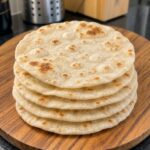
Ingredients
You only need a handful of pantry staples:
- 2 cups (320 g) finely ground white rice flour
- 1¼ to 1½ cups (300 to 360 ml) boiling water, added gradually
- ½ teaspoon (3 g) salt
- 2 to 3 tablespoons rice flour, for dusting and shaping as needed
Ingredient Notes
White rice flour. Choose a finely ground white rice flour for the smoothest dough and the most tender flatbread. Coarser flours can produce a slightly gritty, more fragile result. If you are cooking gluten-free for medical reasons, look for flour labeled certified gluten-free, since cross-contact can happen during processing.
Boiling water. The water must be truly hot. Lukewarm water will not hydrate the flour the same way, and the dough will be dry, cracky, and hard to shape. Add the water gradually, because different brands absorb different amounts.
Salt. Just half a teaspoon gives the flatbread a balanced, savory flavor. Fine salt dissolves most evenly.
Instructions
Step 1: Combine the Dry Ingredients
Place the white rice flour and salt in a large heatproof bowl. Stir briefly with a wooden spoon or whisk so the salt is distributed evenly through the flour.
Step 2: Add the Boiling Water
Carefully pour about 1¼ cups (300 ml) of boiling water into the flour while stirring continuously with a sturdy wooden spoon. Keep mixing until the water is absorbed and the flour forms a rough, crumbly dough.
If the mixture looks too dry, add more boiling water one tablespoon at a time. The goal is a dough that is moist and moldable, not wet or runny.
Step 3: Let the Dough Cool
Let the mixture rest for about 5 to 8 minutes, until it is cool enough to handle safely. During this time the rice flour keeps absorbing the hot water, and the dough becomes easier to work with.
Step 4: Bring the Dough Together
With clean hands, gently press and knead the dough for 2 to 3 minutes until it forms a relatively smooth, cohesive mass. Remember that rice flour has no gluten, so the dough will not become stretchy like wheat dough. That is normal.
- If the dough feels too dry or cracks a lot, add warm water one teaspoon at a time.
- If it feels sticky, dust it lightly with rice flour.
Step 5: Divide the Dough
Divide the dough into 8 equal portions and roll each gently between your palms into a ball. Keep the dough you are not working with covered by a clean kitchen towel or plastic wrap, because rice flour dough dries out quickly.
Step 6: Shape the Flatbreads
Place one dough ball between two sheets of parchment paper and press it gently with your hands. Roll it into a circle about 6 to 7 inches (15 to 18 cm) wide and 2 to 3 mm thick.
Peel away the top sheet of parchment, then lift the flatbread with the bottom sheet and release it onto your hand or straight into the skillet. Repeat with the remaining dough balls.
Step 7: Heat the Skillet
Set a nonstick skillet or well-seasoned cast-iron pan over medium to medium-high heat and let it heat thoroughly. Keep the pan dry, since no oil is needed.
Step 8: Cook the First Side
Place one flatbread in the hot skillet. Cook for about 1 to 2 minutes, until the surface looks dry, small bubbles appear, and the underside develops a few light golden spots.
Step 9: Flip and Finish Cooking
Flip the flatbread with a thin spatula and cook the second side for another 1 to 2 minutes, until lightly toasted and cooked through. If you like, flip it once more briefly to encourage extra puffing. Avoid overcooking, which makes rice flour flatbread dry and brittle.
Step 10: Keep the Flatbreads Soft
Move each cooked flatbread straight onto a clean kitchen towel. Stack them as they finish and fold the towel over the top. The trapped warmth and moisture keep them soft and flexible.
Step 11: Rest and Serve
When all the flatbreads are cooked, let the covered stack rest for about 5 minutes, then serve warm.
- Prep Time: 15 minutes
- Cook Time: 20 to 25 minutes