Ingredients
For the stuffed peppers
- 6 medium poblano peppers
- 12 oz panela cheese, cut into thick pieces
- ½ cup all-purpose flour, for coating
- 6 large eggs, separated
- ½ teaspoon salt, or to taste
- ¼ teaspoon black pepper
- 1 cup vegetable oil, or as needed for frying
For the tomato sauce
- 4 medium ripe tomatoes
- 2 cloves garlic
- ¼ small white onion
- ½ teaspoon ground cumin (optional)
- ½ cup chicken broth or water
- ½ teaspoon dried oregano
- Salt and black pepper, to taste
- Fresh cilantro, optional, for garnish
How to Choose the Best Poblano Peppers
The pepper is the star of the dish, so shop carefully. The poblano is a mild to medium chile with deep green color and a rich, earthy flavor that becomes smoky and slightly sweet when roasted.
Look for peppers that are:
- Large and wide enough to stuff. Small, narrow peppers are difficult to fill.
- Firm and glossy, with smooth, taut skin and no soft spots.
- Free of tears and deep wrinkles. A cracked pepper will leak cheese during frying.
- Relatively flat or straight-sided, which makes roasting and peeling more even.
As for heat, poblanos are generally mild, although every so often one has a surprising kick. If you are cooking for children or anyone sensitive to spice, removing the seeds and the white inner membranes carefully will reduce the heat even more.
Instructions
Rinse the poblano peppers and pat them completely dry. Place them on a hot flat skillet, a comal, or directly over a gas flame. Turn them every so often until the skins are blistered and charred on all sides.
Do not be afraid of the black spots. The charring is what loosens the skin and creates the signature smoky flavor. If you do not have a gas stove, a hot cast-iron skillet or a comal works nicely. An oven broiler is another option: place the peppers on a baking sheet close to the heat and turn them until blistered.
Transfer the hot peppers to a heat-safe bowl or bag and cover loosely. Let them steam for about 10 minutes. This trapped steam separates the skin from the flesh. Once the peppers are cool enough to handle, gently rub away the charred skins with your fingers.
Try to avoid rinsing the peppers under running water. Water washes away some of the smoky flavor and makes the peppers slippery and wet, which will cause trouble later when you coat them. If a few small bits of skin remain, that is perfectly fine.
Make a small lengthwise slit in each pepper. Carefully remove the seeds and inner membranes, keeping the stems and the peppers as intact as possible. Pat the peppers dry with paper towels, inside and out.
Keeping the stem attached is traditional and gives you a handy “handle” when dipping and turning the pepper. A small slit is better than a large one: the smaller the opening, the less likely the cheese is to escape.
Cut the panela into thick pieces that fit comfortably inside the peppers. Place one piece in each poblano, taking care not to overfill. Gently press the openings together. If needed, secure the pepper with a toothpick, and remember to remove it before serving.
Thick pieces, rather than thin slices, are important. They melt slowly and stay inside the pepper while the exterior cooks.
Place the flour on a shallow plate. Lightly dust each stuffed poblano with flour, shaking off any excess. This thin layer absorbs surface moisture and gives the egg batter something to cling to. Skipping this step is the number one reason the coating slides off in the pan.
Place the egg whites in a clean, dry mixing bowl. Beat with a hand mixer until the whites are thick, fluffy and able to hold soft peaks. In a separate bowl, lightly beat the egg yolks. Gently fold the yolks into the whites until combined, taking care not to deflate the mixture. Season with the salt and black pepper.
Make sure the bowl and beaters are completely clean and free of grease or any trace of yolk, which can stop the whites from whipping properly. Folding gently, rather than stirring, preserves all those tiny air bubbles that give chiles rellenos their cloud-like texture.
Carefully dip each floured poblano into the fluffy egg mixture, covering it completely. Use a spoon to help coat the sides and top while keeping the pepper intact. Work quickly, because the foam begins to settle the longer it sits.
Heat the vegetable oil in a large skillet over medium heat. Once hot, carefully place the coated peppers in the oil, working in batches if necessary. Fry for about 3 to 4 minutes per side, gently turning until the egg coating is puffed and golden brown. Transfer to a paper towel-lined plate to drain excess oil.
A wide spatula makes turning much easier. Do not crowd the pan, since overcrowding lowers the oil temperature and can lead to greasy, pale peppers. If the oil is too hot, the coating browns before the cheese softens; if it is too cool, the coating soaks up oil. Medium heat is the sweet spot.
Place the tomatoes, garlic, onion, cumin if using, oregano and ½ cup chicken broth or water in a blender. Blend until smooth. Season with salt and black pepper to taste.
Pour the blended tomato mixture into a saucepan or deep skillet. Bring it to a gentle simmer over medium heat, then cook for 8 to 12 minutes, stirring occasionally, until the sauce darkens slightly and the flavors come together. Add a little more broth or water if the sauce becomes too thick.
Carefully place the fried stuffed peppers into the warm tomato sauce. Spoon some sauce over each pepper and simmer gently for 3 to 5 minutes. Avoid vigorous stirring, which can break the delicate egg coating.
This short simmer allows the coating to soak up a little of the sauce, becoming tender and flavorful, while the cheese inside finishes melting into a creamy center.
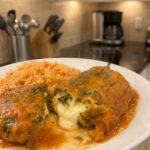
Transfer the chiles rellenos to serving plates and spoon extra tomato sauce over the top. Garnish with fresh cilantro if desired. Serve immediately with Mexican-style rice and warm beans for a comforting, traditional meal.