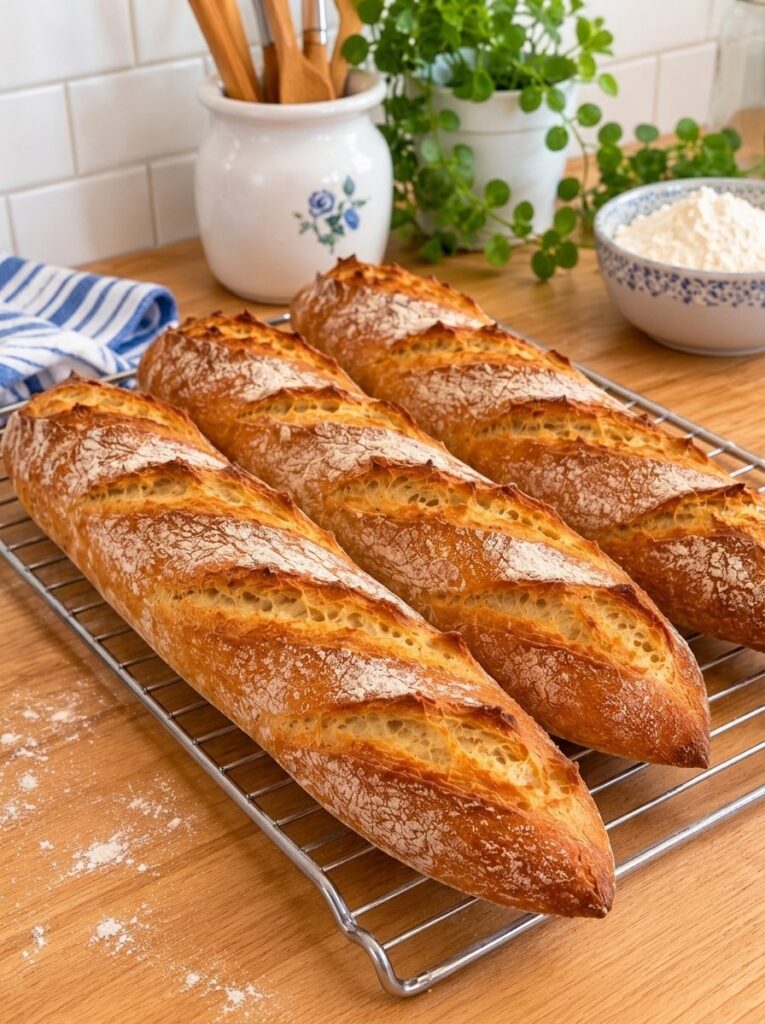
There is something almost magical about pulling a tray of homemade baguettes out of your own oven. The kitchen fills with the smell of toasted wheat, the crust crackles as it cools, and the golden-brown loaves look like they came straight from a French boulangerie. You do not need a professional oven, a baker’s couche, or years of experience to make them.
These Crispy Golden Homemade Baguettes have everything you love about classic French bread: a beautifully golden, crackly crust, a soft and airy interior, and a wonderfully chewy texture. They use four simple pantry ingredients (bread flour, water, yeast, and salt) and develop their flavor through gentle mixing, proper resting, and careful shaping. A little steam in the oven creates the signature crisp crust.
This guide covers the full baguette recipe, step-by-step instructions, the science behind a crisp crust, troubleshooting help, serving ideas, storage and freezing tips, and answers to common questions.
Why You’ll Love This Homemade Baguette Recipe
- Simple ingredients. Bread flour, lukewarm water, instant yeast, salt, and a little olive oil for greasing the bowl.
- Beginner-friendly. No starter, no overnight preferment, and no special equipment.
- Impressive results. Deeply golden loaves with a crackly crust, shallow diagonal scores, and an open, airy crumb.
- Completely vegan. Naturally dairy-free and vegan with the listed ingredients.
- Versatile. One batch makes three baguettes, perfect for sandwiches, garlic bread, bruschetta, soup, or a cheese board.
- Freezer-friendly. Bake once and enjoy fresh-tasting bread for weeks.
What Makes a Great Baguette?
A traditional French baguette is defined by contrast: a thin, shatteringly crisp, golden outside and a soft, chewy inside full of irregular air pockets. That contrast comes down to four things:
- Gluten development. Bread flour has more protein than all-purpose flour, forming the strong gluten network needed for a chewy, airy crumb.
- Fermentation. Time develops flavor and structure, and creates the air pockets that make baguettes light.
- Shaping with tension. A firmly rolled loaf holds its shape and bakes into a smooth, even cylinder.
- Steam and high heat. Steam keeps the crust flexible at the start of baking so the loaf can expand, then evaporates to leave a thin, crisp, golden crust.
Ingredients for Homemade Baguettes
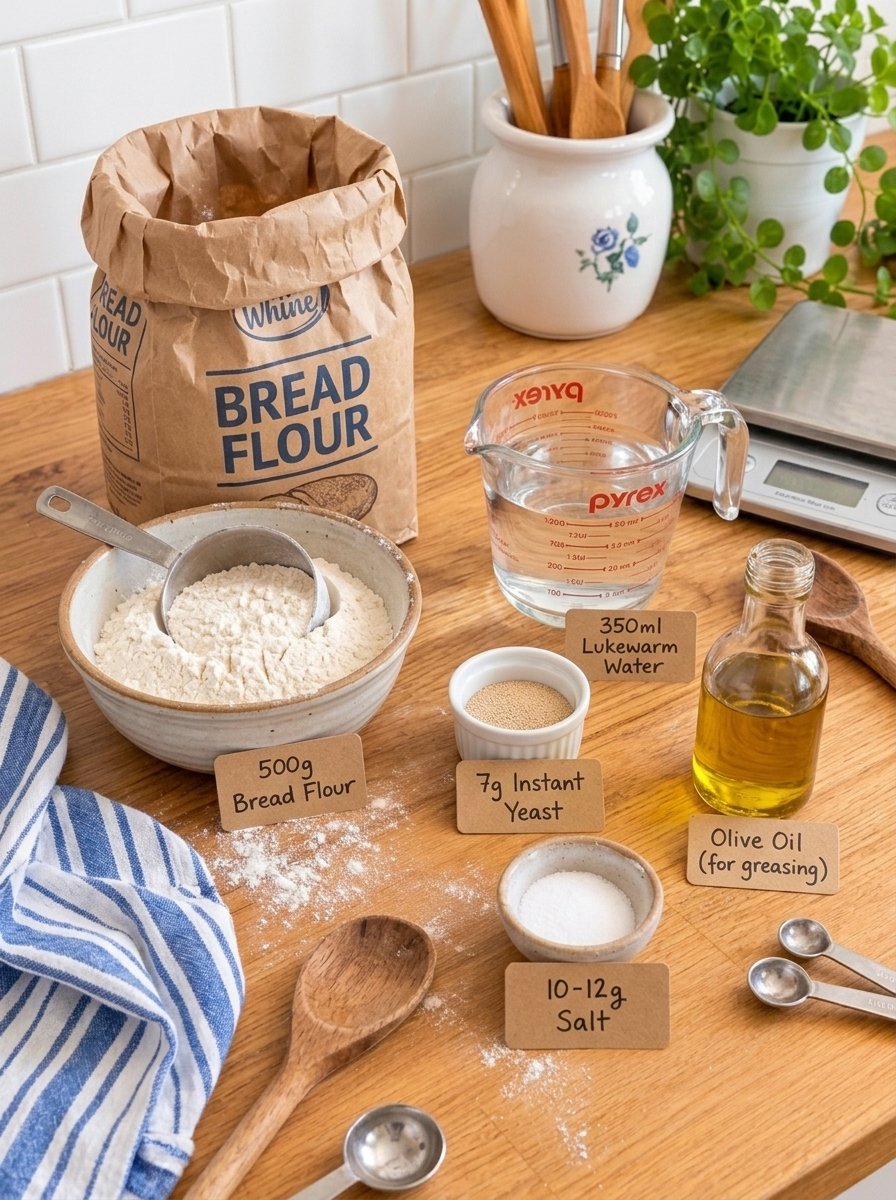
This recipe makes 3 baguettes, each about 14 to 16 inches (35 to 40 cm) long.
- 500 g (4 cups) bread flour, plus a little extra for dusting
- 350 ml (1½ cups minus 1 tablespoon) lukewarm water
- 7 g (2¼ teaspoons) instant yeast
- 10 to 12 g (2 teaspoons) salt
- A little olive oil, for greasing the bowl
- Extra flour or semolina, for dusting the work surface
Ingredient Notes and Substitutions
Bread flour. Its higher protein content builds more gluten, which gives baguettes their chew and airy interior. All-purpose flour can work in a pinch, but the crumb will be softer and the dough slacker.
Water. Use lukewarm water, comfortable to the touch but not hot. Hot water can damage the yeast, and cold water slows fermentation. The dough should be soft and slightly sticky.
Yeast. Instant yeast mixes directly into the flour. If you only have active dry yeast, dissolve it in the lukewarm water for 5 to 10 minutes until foamy first.
Salt. Salt strengthens the dough, controls fermentation, and adds flavor. Don’t skip it, or the baguettes will taste flat.
Semolina. Dusting your work surface with a little semolina helps prevent sticking and adds a subtle rustic texture.
Equipment You Will Need
- A large mixing bowl and a second bowl for rising
- A wooden spoon (or just your hands)
- A bench scraper or sharp knife
- A baking sheet lined with parchment, or a baguette pan
- A sharp bread lame or razor blade
- An empty metal baking pan for steam
- A wire cooling rack and a clean kitchen towel
How to Make Crispy Golden Homemade Baguettes (Step by Step)
Step 1: Prepare the Dough
In a large bowl, combine the bread flour and instant yeast. Add the lukewarm water and mix with a wooden spoon or your hands until a rough, shaggy dough forms. Add the salt and mix until evenly distributed.
Knead gently for 8 to 10 minutes by hand, until the dough is smooth, elastic, and slightly tacky. Resist adding lots of extra flour. A slightly sticky dough gives a lighter, more open crumb, while too much flour leads to dense baguettes.
Step 2: Let the Dough Rise
Lightly grease a clean bowl with olive oil. Transfer the dough into it, turning once to coat the surface. Cover with plastic wrap or a clean kitchen towel.
Let it rise in a warm, draft-free place for 1 to 1½ hours, or until doubled in size. Timing depends on your kitchen temperature and yeast activity, so watch the dough rather than the clock.
Step 3: Divide the Dough
Lightly dust your work surface with flour. Gently turn the risen dough out without pressing out too much air. Divide it into 3 equal portions with a bench scraper or sharp knife.
Shape each portion into a loose rectangle, cover with a towel, and rest for 15 to 20 minutes. This lets the gluten relax, which makes shaping easier.
Step 4: Shape the Baguettes
- Gently flatten one portion into a rectangle.
- Fold the top edge toward the center and press gently to seal.
- Fold the bottom edge up over the first fold and press the seam firmly closed.
- Fold the dough lengthwise once more and seal the seam.
- With both hands, roll the dough back and forth from the center outward until it forms a baguette about 14 to 16 inches (35 to 40 cm) long.
- Taper the ends slightly and repeat with the remaining portions.
Aim for a smooth, taut surface with the seam on the bottom. Roll firmly enough to build tension, but not so hard that you push out all the air.
Step 5: Allow the Baguettes to Rise Again
Place the shaped baguettes seam-side down on a lightly floured baguette pan or parchment-lined baking sheet, with space between them. On a regular sheet, you can fold parchment between the loaves to support their shape.
Cover loosely with a towel and let rise for 30 to 45 minutes, until noticeably puffy. Avoid overproofing, which can make them lose their shape in the oven.
Step 6: Prepare the Oven and Score the Dough
Preheat your oven to 475°F (245°C). Place an empty metal baking pan on the lower rack while preheating; this will create steam.
When the baguettes have finished rising, uncover them and lightly dust the tops with flour if desired. Using a sharp lame or razor blade, make 3 to 5 diagonal slashes along each baguette, holding the blade at a slight angle. Make shallow, confident cuts with one smooth stroke each.
Step 7: Bake Until Crispy and Golden
Carefully transfer the baguettes into the oven. Pour about 1 cup of hot water into the preheated pan on the lower rack to create steam, and close the door immediately, keeping your face and hands away from the escaping steam.
Bake for 10 to 12 minutes with steam. Then remove the steam pan if it is safe to do so, and bake another 10 to 15 minutes, until the crust is deep golden brown.
The baguettes should sound hollow when tapped on the bottom, and the internal temperature should reach about 205 to 210°F (96 to 99°C).
Step 8: Cool Before Serving
Transfer the baguettes immediately to a wire rack. Cool for at least 30 to 45 minutes before slicing so the crumb can finish setting while the crust stays crisp. Don’t cover them while warm, since trapped moisture softens the crust. You may hear the crust gently crackle as it cools, which is a good sign.
Step 9: Slice and Enjoy
Slice with a sharp serrated bread knife and serve fresh with butter, olive oil, cheese, or your favorite spreads.
Tips for the Best Crispy Golden Homemade Baguettes
- Use bread flour for chew and an airy interior.
- Measure the water carefully. The dough should be soft and slightly sticky; too much extra flour makes baguettes dense.
- Don’t skip the resting periods. They develop flavor, improve structure, and create air pockets.
- Handle the dough gently so the loaves stay light.
- Create surface tension with a firm roll for a smooth outer surface.
- Use steam so the baguettes expand fully before the crust sets.
- Score just before baking with a sharp blade and clean diagonal cuts.
- Bake until deeply golden. A pale crust lacks crispness and flavor.
- Cool on a wire rack so the bottom crust doesn’t soften.
Why Steam Matters for a Crispy Baguette Crust
When dough first enters a hot oven, its surface is still moist and flexible. Steam keeps it that way for several extra minutes, allowing the loaf to expand fully (called “oven spring”) before the crust sets. Surface moisture also helps starches gelatinize and brown, giving the crust its deep color and subtle shine. Once the steam pan is removed, dry heat hardens the crust into a crisp shell.
In a home oven, a pan of hot water on the lower rack is the simplest way to create steam. Pour carefully and keep your hands and face clear.
Common Baguette Problems and How to Fix Them
My baguettes are dense. This usually means too much added flour, underproofing, or heavy handling. Keep the dough slightly sticky, let it fully double, and shape gently.
My crust is pale or soft. Make sure the oven is fully preheated to 475°F (245°C), use steam for the first 10 to 12 minutes, bake until deeply golden, and cool uncovered on a wire rack.
My baguettes spread out flat. They may be overproofed or shaped without enough tension. Watch the second rise (30 to 45 minutes is usually enough), roll firmly, and support the loaves with parchment folds.
My scoring didn’t open up. The blade may be dull, the cuts too deep, or the dough overproofed. Use a very sharp blade at a slight angle and make shallow, confident slashes.
The crumb is tight. Insufficient fermentation or too much flour is the likely cause. Let the dough double and avoid degassing it completely.
Serving Ideas for Homemade Baguettes
- Classic French breakfast: warm slices with butter, jam, or honey and coffee.
- Garlic bread: brush with garlic butter, sprinkle with parsley, and toast until golden.
- Bruschetta: top toasted slices with diced tomatoes, fresh basil, olive oil, and a little salt.
- Cheese and charcuterie: serve with cheeses, olives, and fresh vegetables.
- Homemade sandwiches: fill with turkey, ham, cheese, lettuce, and tomatoes.
- Soup companion: pair with tomato, French onion, or creamy vegetable soup.
- Olive oil dip: serve with extra virgin olive oil, black pepper, and dried herbs.
- Crispy crostini: slice thin, brush with olive oil, and bake until crisp for an easy appetizer.
How to Store Homemade Baguettes
Baguettes are best the day they are baked, because the thin crust softens as it absorbs moisture from the crumb.
- Room temperature: cool completely, then store in a paper bag or bread box for up to 2 days. Avoid airtight plastic to preserve crispness.
- Refrigeration: not recommended, as it makes baguettes stale and firm more quickly.
- Freezing: once completely cooled, wrap each baguette tightly in plastic wrap or foil and place in a freezer-safe bag for up to 2 to 3 months.
- Reheating: sprinkle the crust lightly with water and heat in a preheated 350°F (175°C) oven for 5 to 8 minutes.
- From frozen: thaw at room temperature, then refresh at 350°F (175°C) for 8 to 12 minutes until crisp.
Don’t Waste Stale Baguettes
Slightly stale baguettes make excellent croutons, breadcrumbs, or French toast. The firm crumb soaks up custard without falling apart.
Recipe Details at a Glance
- Prep time: 25 minutes
- First rise: 1 to 1½ hours
- Resting time: 15 to 20 minutes
- Second rise: 30 to 45 minutes
- Bake time: 20 to 27 minutes
- Cooling time: 30 to 45 minutes
- Total time: about 3 to 4 hours
- Yield: 3 baguettes, 14 to 16 inches each
- Course: Bread, breakfast, side dish
- Cuisine: French
- Difficulty: Easy to moderate
- Baking temperature: 475°F (245°C)
- Dietary notes: Naturally dairy-free and vegan with the listed ingredients. Contains gluten.
Frequently Asked Questions About Homemade Baguettes
Can I make baguettes without a baguette pan?
Yes. A parchment-lined baking sheet works well. Space the loaves apart and fold parchment between them to help them keep their shape while proofing.
Can I use all-purpose flour instead of bread flour?
You can, but bread flour is recommended for better chew and structure. All-purpose flour gives a slightly softer crumb and a dough that is harder to shape.
Why do I need steam?
Steam keeps the crust flexible early in baking so the baguettes expand fully, then helps produce a thin, glossy, crisp crust once removed.
How do I know when my baguettes are done?
Look for a deep golden-brown crust. They should sound hollow when tapped on the bottom, with an internal temperature of about 205 to 210°F (96 to 99°C).
How long do homemade baguettes last?
Up to 2 days in a paper bag or bread box, or 2 to 3 months in the freezer.
Are these baguettes vegan?
Yes. With bread flour, water, yeast, salt, and olive oil, they are naturally dairy-free and vegan. They do contain gluten.
Why is my dough so sticky?
It’s meant to be soft and slightly tacky. Lightly flour your hands and surface rather than adding extra flour to the dough, and let the gluten develop through kneading and resting.
Final Thoughts: Bakery-Style Baguettes From Your Own Kitchen
Making homemade baguettes may seem intimidating at first, but this recipe shows it doesn’t have to be. With simple ingredients, patient resting periods, careful shaping, and a little steam, you can bake loaves with a crackly golden crust and a soft, airy, chewy interior that rival your favorite bakery.
Print
Crispy Golden Homemade Baguettes
- Total Time: 3 to 4 hours
- Yield: 3 baguettes, 14 to 16 inches each 1x
Ingredients
This recipe makes 3 baguettes, each about 14 to 16 inches (35 to 40 cm) long.
- 500 g (4 cups) bread flour, plus a little extra for dusting
- 350 ml (1½ cups minus 1 tablespoon) lukewarm water
- 7 g (2¼ teaspoons) instant yeast
- 10 to 12 g (2 teaspoons) salt
- A little olive oil, for greasing the bowl
- Extra flour or semolina, for dusting the work surface
Ingredient Notes and Substitutions
Bread flour. Its higher protein content builds more gluten, which gives baguettes their chew and airy interior. All-purpose flour can work in a pinch, but the crumb will be softer and the dough slacker.
Water. Use lukewarm water, comfortable to the touch but not hot. Hot water can damage the yeast, and cold water slows fermentation. The dough should be soft and slightly sticky.
Yeast. Instant yeast mixes directly into the flour. If you only have active dry yeast, dissolve it in the lukewarm water for 5 to 10 minutes until foamy first.
Salt. Salt strengthens the dough, controls fermentation, and adds flavor. Don’t skip it, or the baguettes will taste flat.
Semolina. Dusting your work surface with a little semolina helps prevent sticking and adds a subtle rustic texture.
Instructions
Step 1: Prepare the Dough
In a large bowl, combine the bread flour and instant yeast. Add the lukewarm water and mix with a wooden spoon or your hands until a rough, shaggy dough forms. Add the salt and mix until evenly distributed.
Knead gently for 8 to 10 minutes by hand, until the dough is smooth, elastic, and slightly tacky. Resist adding lots of extra flour. A slightly sticky dough gives a lighter, more open crumb, while too much flour leads to dense baguettes.
Step 2: Let the Dough Rise
Lightly grease a clean bowl with olive oil. Transfer the dough into it, turning once to coat the surface. Cover with plastic wrap or a clean kitchen towel.
Let it rise in a warm, draft-free place for 1 to 1½ hours, or until doubled in size. Timing depends on your kitchen temperature and yeast activity, so watch the dough rather than the clock.
Step 3: Divide the Dough
Lightly dust your work surface with flour. Gently turn the risen dough out without pressing out too much air. Divide it into 3 equal portions with a bench scraper or sharp knife.
Shape each portion into a loose rectangle, cover with a towel, and rest for 15 to 20 minutes. This lets the gluten relax, which makes shaping easier.
Step 4: Shape the Baguettes
- Gently flatten one portion into a rectangle.
- Fold the top edge toward the center and press gently to seal.
- Fold the bottom edge up over the first fold and press the seam firmly closed.
- Fold the dough lengthwise once more and seal the seam.
- With both hands, roll the dough back and forth from the center outward until it forms a baguette about 14 to 16 inches (35 to 40 cm) long.
- Taper the ends slightly and repeat with the remaining portions.
Aim for a smooth, taut surface with the seam on the bottom. Roll firmly enough to build tension, but not so hard that you push out all the air.
Step 5: Allow the Baguettes to Rise Again
Place the shaped baguettes seam-side down on a lightly floured baguette pan or parchment-lined baking sheet, with space between them. On a regular sheet, you can fold parchment between the loaves to support their shape.
Cover loosely with a towel and let rise for 30 to 45 minutes, until noticeably puffy. Avoid overproofing, which can make them lose their shape in the oven.
Step 6: Prepare the Oven and Score the Dough
Preheat your oven to 475°F (245°C). Place an empty metal baking pan on the lower rack while preheating; this will create steam.
When the baguettes have finished rising, uncover them and lightly dust the tops with flour if desired. Using a sharp lame or razor blade, make 3 to 5 diagonal slashes along each baguette, holding the blade at a slight angle. Make shallow, confident cuts with one smooth stroke each.
Step 7: Bake Until Crispy and Golden
Carefully transfer the baguettes into the oven. Pour about 1 cup of hot water into the preheated pan on the lower rack to create steam, and close the door immediately, keeping your face and hands away from the escaping steam.
Bake for 10 to 12 minutes with steam. Then remove the steam pan if it is safe to do so, and bake another 10 to 15 minutes, until the crust is deep golden brown.
The baguettes should sound hollow when tapped on the bottom, and the internal temperature should reach about 205 to 210°F (96 to 99°C).
Step 8: Cool Before Serving
Transfer the baguettes immediately to a wire rack. Cool for at least 30 to 45 minutes before slicing so the crumb can finish setting while the crust stays crisp. Don’t cover them while warm, since trapped moisture softens the crust. You may hear the crust gently crackle as it cools, which is a good sign.
Step 9: Slice and Enjoy
Slice with a sharp serrated bread knife and serve fresh with butter, olive oil, cheese, or your favorite spreads.
- Prep Time: 25 minutes
- Cook Time: 20 to 27 minutes