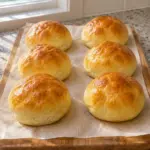
Ingredients
- 1 cup (225 g) small-curd cottage cheese, preferably 2% or full-fat
- 1⅔ cups (200 g) self-rising flour, plus a little for shaping
- 1 large egg, beaten, for brushing
Ingredient Notes and Substitutions
Small-Curd Cottage Cheese
Cottage cheese is the star of this recipe, and it plays several roles. It provides the moisture that hydrates the flour, it adds a mild tang and richness, and it contributes to the soft, tender crumb. Small-curd cottage cheese blends more easily than large-curd, though either will work if you blend it long enough.
Choose 2% or full-fat for the best flavor and texture. Fat-free cottage cheese is often wetter and less rich, so the rolls may be a little less tender. Before measuring, pour off any liquid that has pooled on top of the container. Extra liquid can make the dough too wet and sticky.
For accuracy, weigh the cottage cheese if you have a kitchen scale. One cup is about 225 g in this recipe.
Self-Rising Flour
Self-rising flour is simply flour that already contains baking powder and salt. That is what allows these rolls to rise with no yeast. Use a fresh bag, because baking powder loses its strength over time, and old self-rising flour can produce flat, dense rolls.
If you do not have self-rising flour, you can make a substitute. For every 1 cup of all-purpose flour, whisk in 1½ teaspoons of baking powder and ¼ teaspoon of fine salt. For this recipe, that works out to roughly 1⅔ cups (200 g) of all-purpose flour with about 2½ teaspoons of baking powder and a scant ½ teaspoon of salt. Whisk it well so the leavening is evenly distributed.
For the most reliable results, weigh your flour. Scooping flour straight from the bag can pack in more than intended and lead to a dry dough.
The Egg Wash
The egg is used only for brushing, and it is what gives the rolls their shiny, deep golden tops. Beat the egg until the white and yolk are fully combined, and apply a thin, even layer. If you prefer, you can add a teaspoon of water or milk to the egg to make it easier to brush. For a dairy-free or egg-free shine, brush the tops with a little milk or olive oil, though the color and gloss will be different.
Instructions
Heat the oven to 400°F (200°C). Line a rimmed baking sheet with parchment paper. Parchment prevents sticking and makes cleanup easy, and it helps the bottoms brown evenly. Make sure your oven is fully preheated before the rolls go in so they get a good initial burst of heat.
Step 2: Blend the Cottage Cheese
Pour off any liquid pooled on top of the cottage cheese before measuring. Add the measured cottage cheese to a blender or food processor and blend until smooth, scraping down the sides as needed. This step matters. Blending turns the curds into a creamy puree, so the dough is even and the finished rolls have a smooth, fine crumb with no cottage cheese lumps.
Step 3: Mix the Dough
Place the self-rising flour in a mixing bowl. Stir the blended cottage cheese into the flour just until a soft, slightly tacky dough forms. Turn the dough onto a lightly floured surface and gently press it together. Avoid overworking it. Because the dough contains baking powder rather than yeast, it does not need kneading, and too much handling can make the rolls tough.
Step 4: Shape and Brush
Divide the dough into six pieces, about 70 g each. Tuck the edges of each piece underneath to form a round. Place the rolls seam-side down about 2 inches apart on the baking sheet. Space matters, since the rolls will puff up and spread slightly. Brush the tops lightly with beaten egg, covering the surface evenly but without letting the egg pool around the base.
Step 5: Bake and Cool
Bake for 20 to 24 minutes, until the tops are deep golden and the sides are set. Transfer the rolls to a wire rack and cool for 10 minutes before splitting. The short rest lets the crumb finish setting, which gives you a better texture when you cut into them.