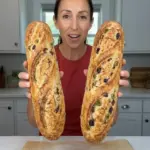
Ingredients
For the dough
- 4 cups (500 g) bread flour or all-purpose flour
- 1½ cups (360 ml) lukewarm water
- 2¼ teaspoons (7 g) instant yeast
- 1 teaspoon sugar or honey
- 1½ teaspoons salt
- 1 tablespoon olive oil
For the olive filling
- ¾ cup (100 to 120 g) pitted olives, roughly chopped
- 1 teaspoon dried oregano
- ½ teaspoon dried rosemary
- 1 small garlic clove, finely minced (optional)
- 1 tablespoon chopped fresh parsley (optional)
For finishing
- A little flour, for dusting
- Water for creating steam in the oven
- A little olive oil, optional
A Closer Look at the Key Ingredients
Bread flour or all-purpose flour. Bread flour has more protein, which builds a stronger gluten network and a chewier, more structured crumb, ideal for baguettes. All-purpose flour produces a slightly softer loaf. Both work well.
Lukewarm water. At 360 ml of water to 500 g of flour, the dough is about 72% hydration. That is wet enough to bake into a light, airy crumb but still manageable to shape. The water should be warm, not hot, to avoid damaging the yeast.
Instant yeast. Instant yeast can be mixed straight into the flour. If you only have active dry yeast, dissolve it in the lukewarm water with the sugar and let it stand for 5 to 10 minutes until foamy.
Sugar or honey. Just a teaspoon feeds the yeast and helps the crust brown. It will not make the bread taste sweet.
Salt. Salt flavors the bread and strengthens the dough. Because olives are already salty, this recipe uses a moderate amount in the dough itself.
Olive oil. A tablespoon of olive oil adds flavor and keeps the crumb tender, and it echoes the olives in the filling.
Olives. Green olives, black olives, Kalamata olives, or a mixture all work. Choose pitted olives you enjoy eating on their own, and chop them into small pieces so they distribute evenly.
Oregano, rosemary, garlic, and parsley. These herbs reinforce the Mediterranean flavor. Garlic and fresh parsley are optional but add extra fragrance.
Instructions
Step 1: Prepare the Olives
Choose your favorite green olives, black olives, or a combination of both.
Remove the pits if necessary and chop the olives into small pieces.
Place them on paper towels and pat dry to remove excess moisture.
In a small bowl, combine the olives with oregano, rosemary, garlic, and parsley if using.
Set aside.
Tip: If your olives are very salty, rinse them briefly and pat them completely dry before adding them to the dough.
Step 2: Prepare the Yeast Mixture
In a large mixing bowl, combine the lukewarm water, yeast, and sugar.
Stir gently.
If using active dry yeast, let the mixture stand for 5 to 10 minutes until foamy. If using instant yeast, you can mix it directly into the flour instead.
Make sure the water is warm, not hot.
Step 3: Mix the Dough
Add the flour, salt, and olive oil to the yeast mixture.
Stir with a wooden spoon until a rough, slightly sticky dough forms and no dry flour remains.
The dough should feel soft and elastic. Avoid adding too much extra flour, as a softer dough helps create a light, airy baguette.
Step 4: Knead the Dough
Transfer the dough to a lightly floured work surface.
Knead for approximately 8 to 10 minutes until smooth and elastic.
Alternatively, use a stand mixer with a dough hook for about 5 to 7 minutes on low to medium speed.
The dough should become stretchy and manageable while remaining slightly tacky.
Step 5: Add the Olives
Flatten the dough gently into a rectangle.
Scatter the chopped olive mixture evenly over the surface.
Fold the dough over the olives and gently knead or fold until the pieces are distributed throughout.
Avoid overworking the dough, as the olives may release moisture and make it sticky.
Adding the olives after kneading is deliberate. If they go in earlier, the mixer or kneading can tear and bruise them, and they can streak the dough and release extra moisture.
Step 6: First Rise
Lightly grease a large bowl with olive oil.
Place the dough inside, turning it once to coat the surface.
Cover with plastic wrap or a clean kitchen towel.
Let it rise in a warm place for 60 to 90 minutes, or until approximately doubled in size.
Step 7: Divide and Shape the Baguettes
Transfer the risen dough onto a lightly floured surface.
Divide it into two equal portions.
Working with one portion at a time:
- Gently flatten the dough into a rectangle.
- Fold the top edge toward the center and press gently.
- Fold the bottom edge upward and press again.
- Fold the dough in half lengthwise and pinch the seam closed.
- Roll gently with your hands to form a long baguette, approximately 12 to 14 inches (30 to 35 cm) long.
Taper the ends slightly for a traditional baguette shape.
Repeat with the second portion.
Place the baguettes seam-side down on a parchment-lined baking tray, leaving space between them.
Step 8: Second Rise
Cover the shaped baguettes loosely with a clean kitchen towel.
Let them rise for another 30 to 40 minutes, until puffy.
Meanwhile, preheat the oven to 450°F (230°C).
Step 9: Score the Baguettes
Using a sharp knife or bread lame, make 3 to 4 diagonal cuts along the top of each baguette.
Each cut should be approximately ¼ inch (6 mm) deep.
Scoring allows the bread to expand properly during baking and gives the baguettes their beautiful bakery-style appearance.
Step 10: Create Steam and Bake
Place an empty metal baking pan on the bottom rack while the oven preheats.
Transfer the baguettes to the oven.
Carefully pour about 1 cup of hot water into the empty metal pan to create steam. Keep your face and hands away from the steam.
Bake for 22 to 28 minutes, or until the baguettes are golden brown with crisp crusts.
The bread should sound hollow when tapped underneath.
Carefully remove the steam pan once it has cooled enough to handle.
Step 11: Cool and Serve
Transfer the baguettes to a wire rack.
Allow them to cool for at least 30 minutes before slicing.
This gives the interior time to set, keeping the crumb soft and preventing a gummy texture.
Enjoy your freshly baked olive baguettes.