Ingredients
Here is everything you need for one 9 × 5-inch loaf:
- 3⅓ cups bread flour (400 g), spooned and leveled
- 1 cup cottage cheese (225 g)
- 2 large eggs, room temperature
- 2¼ teaspoons instant yeast (7 g)
- 2 tablespoons olive oil (30 ml)
- 1 tablespoon granulated sugar (12 g)
- 1 teaspoon salt (6 g)
- 2 tablespoons fresh chives, finely chopped
- 1 tablespoon fresh dill, finely chopped
- 1 teaspoon garlic powder
- 2–4 tablespoons warm water, as needed
- 1 tablespoon milk or beaten egg, for brushing (optional)
- 1 teaspoon sesame seeds or everything bagel seasoning, for topping (optional)
Ingredient Notes and Smart Substitutions
Bread flour. Bread flour is the best choice here because its higher protein content builds a stronger gluten network, which means a chewier, taller loaf. If you only have all-purpose flour, you can still bake the bread, but expect a slightly softer, less chewy texture and possibly a little more stickiness in the dough.
Cottage cheese. Small-curd cottage cheese blends easily, and full-fat or low-fat versions both work. Full-fat gives the richest flavor and softest crumb, while low-fat keeps things lighter. Because brands vary in moisture, you may need to adjust the water. If your cottage cheese is very wet, pour off any excess liquid before blending.
Eggs. Room-temperature eggs blend more easily into the cottage cheese mixture and help the yeast stay happy. If you forget to take them out ahead of time, place them in a bowl of warm tap water for five minutes.
Instant yeast. Instant yeast can be mixed right into the dry ingredients. If you only have active dry yeast, dissolve it in a few tablespoons of the warm water first and allow it to foam for about five to ten minutes before adding it to the wet ingredients. Expect the rise to take a little longer.
Fresh herbs. Fresh chives and dill are what give this loaf its signature taste. Chop them finely so they distribute evenly and do not tear the dough. If you must use dried dill, start with about one teaspoon, since dried herbs are more concentrated, and skip dried chives if possible as they lose most of their flavor.
Olive oil. A mild olive oil adds tenderness without overpowering the herbs. Melted butter is a good alternative if you prefer a richer flavor.
Toppings. Everything bagel seasoning is the obvious choice, but sesame seeds, poppy seeds or a sprinkle of extra chopped herbs all look beautiful on the golden crust.
Instructions
Total time: approximately 3 to 4 hours, most of which is hands-off rising and cooling time.
Add the cottage cheese to a blender or food processor and blend until completely smooth and creamy. This is a small step that makes a big difference. Blending prevents large curds from creating uneven pockets in the finished bread and gives you a uniform, tender crumb.
In a large mixing bowl, combine the blended cottage cheese, eggs, olive oil and sugar. Whisk until the mixture is smooth and evenly combined. The sugar gives the yeast a little food and adds a hint of sweetness that balances the savory herbs.
In a separate bowl, whisk together the bread flour, instant yeast, salt and garlic powder. Add the chopped chives and dill and toss gently so the herbs are coated in flour and distributed throughout. Coating the herbs this way helps keep them from clumping.
Gradually add the dry ingredients to the cottage cheese mixture. Stir with a wooden spoon, or use a stand mixer fitted with a dough hook, until a rough dough forms.
Now check the consistency. If the dough feels too dry or stiff, add warm water one tablespoon at a time, up to four tablespoons. You are aiming for a dough that is soft and slightly tacky without being excessively sticky. Remember that cottage cheese brands vary in moisture, so it is better to add water gradually than all at once.
Transfer the dough to a lightly floured work surface and knead for 8 to 10 minutes by hand, or use a stand mixer on medium-low speed for about 6 to 8 minutes. The dough should become smooth, elastic and easy to handle.
Try to resist adding too much extra flour. It is tempting when the dough sticks to your hands, but excess flour can make the finished loaf dense and dry. A lightly floured surface and slightly damp hands are usually enough.
The windowpane test: To check whether the gluten is developed, pinch off a small piece of dough and gently stretch it. If it stretches thin enough to let light pass through without tearing right away, you have kneaded it enough.
Place the dough in a lightly greased bowl and turn it once to coat the surface. Cover with a clean kitchen towel or plastic wrap. Let it rise in a warm place for about 60 to 90 minutes, or until doubled in size. The exact time depends on the temperature of your kitchen. A warmer room speeds things up, while a cool one slows things down.
Gently press the dough to release the excess air. Transfer it to a lightly floured surface and shape it into a smooth loaf. To do this, pat the dough into a rectangle, roll it up snugly from the short side, pinch the seam closed and tuck the ends under.
Place the shaped dough, seam side down, into a greased 9 × 5-inch loaf pan, lined with parchment paper if you like. Gently smooth the surface so the loaf rises evenly.
Cover the loaf loosely and let it rise for another 30 to 45 minutes, until it looks noticeably puffy and has risen close to the top of the pan. Toward the end of the rising time, preheat your oven to 350°F (175°C).
The poke test: Lightly press a floured finger into the dough. If the indentation springs back slowly and only partly, the loaf is ready. If it springs back immediately, give it a little more time. If it does not spring back at all, bake it right away.
If you like, gently brush the surface with milk or beaten egg for a more golden, glossy crust. Sprinkle sesame seeds or everything bagel seasoning over the top. Brushing first helps the toppings stick.
Place the loaf in the preheated oven and bake for 35 to 45 minutes, until the top is golden brown and the loaf is cooked through. If the top browns too quickly, loosely cover it with foil for the final part of baking.
For the most reliable doneness check, use an instant-read thermometer. The center of the loaf should reach roughly 190 to 200°F (88 to 93°C). The bread should also sound hollow when you tap the bottom.
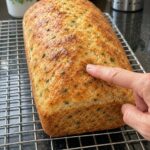
Remove the bread from the oven and let it rest in the pan for about 10 minutes. Carefully transfer it to a wire rack and let it cool completely before slicing. This step matters more than most people realize. Slicing too early releases steam and can leave the crumb gummy, while a fully cooled loaf slices cleanly and has a better texture.
Use a serrated bread knife and a gentle sawing motion to cut even slices. Toasting the slices lightly brings out the savory herbs and the chewy, bagel-like texture.
Serve the bread plain, toasted with butter or spread with cream cheese. It is just as good as the base for egg sandwiches, open-faced lunches and savory snacks.