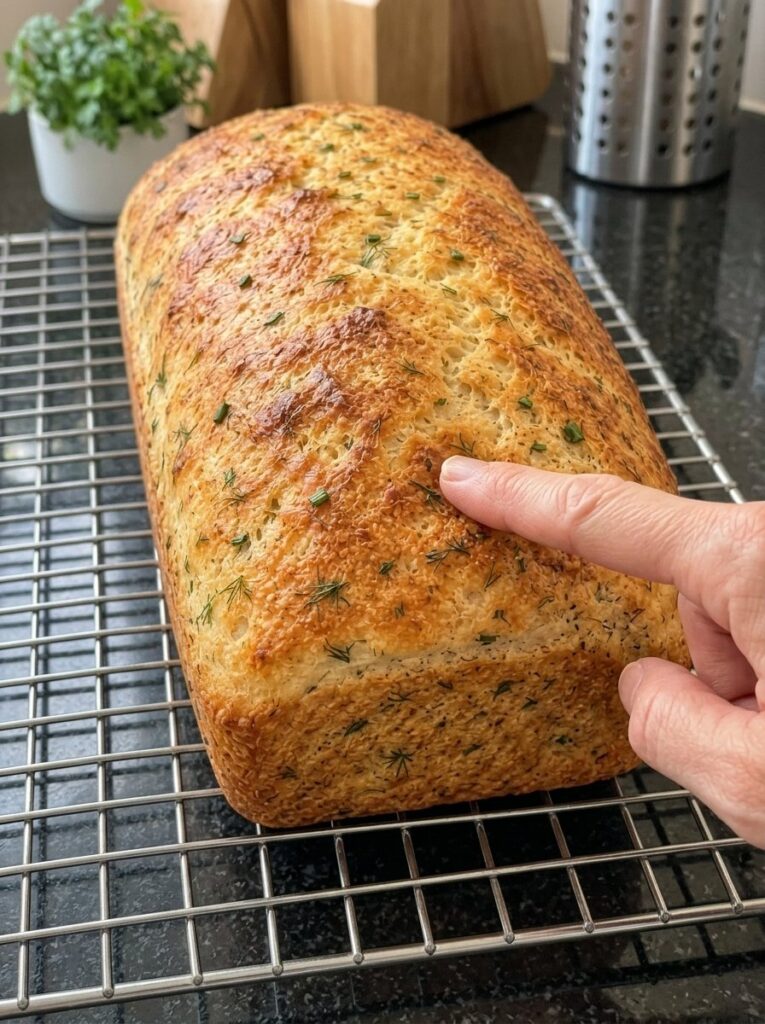
There is something deeply satisfying about pulling a golden, herb-flecked loaf out of your own oven. The crust crackles as it cools, the kitchen smells like garlic and fresh dill, and you know that the first slice, toasted and spread with cream cheese, is only minutes away. This High-Protein Cottage Cheese Chive Dill Bagel Bread delivers all of that, with a flavor that tastes like your favorite everything bagel but in an easy-to-slice sandwich loaf.
If you have been searching for a high-protein bread recipe that does not taste like a compromise, this is the one to bookmark. Blended cottage cheese keeps the crumb tender and moist while adding protein. Bread flour builds a chewy, bagel-like structure. Fresh chives and dill bring a bright, garden-fresh taste, and a little garlic powder ties everything together. The result is a savory yeast bread that works for breakfast, lunch, snacks and everything in between.
In this guide, you will find the full recipe, step-by-step instructions, ingredient notes, troubleshooting help, creative variations, serving ideas and storage tips, so you can bake a perfect loaf the first time.
Why You Will Love This Cottage Cheese Bagel Bread
Before we get into the details, here is why this loaf earns a permanent spot in a home baker’s rotation:
- Higher in protein than a typical sandwich loaf. Cottage cheese and eggs both contribute protein, which makes each slice more filling than standard white bread.
- Soft inside, golden outside. The dairy and eggs create a tender, moist crumb, while the baked top turns beautifully golden.
- Bagel flavor without the boiling. Traditional bagels require shaping, boiling and baking. This loaf gives you that herby, savory bagel taste with simple mixing, kneading and a single bake.
- Fresh herb flavor in every bite. Chives and dill are tiny flavor powerhouses, and they are scattered throughout the crumb.
- Incredibly versatile. Toast it, grill it, turn it into sandwiches, or serve it next to soup.
- Great for meal prep. The loaf slices cleanly once cooled and freezes beautifully.
- Easy to customize. Top it with sesame seeds, poppy seeds or everything bagel seasoning to make it your own.
What Makes This Bread Different?
Most homemade yeast breads rely on water or milk as the main liquid. This recipe uses blended cottage cheese instead. Cottage cheese is mostly milk protein and moisture, so when it is blended smooth, it behaves like a thick, creamy liquid that enriches the dough. The proteins and fat contribute to a soft texture and help the bread stay moist for days.
The eggs add richness, structure and more protein, while olive oil keeps the crumb tender. Bread flour, which has a higher protein content than all-purpose flour, gives the dough the strength it needs to hold air and bake up with that satisfying, chewy bite you expect from a bagel.
Finally, the flavor profile is classic deli: chives, dill and garlic. If you love cream cheese and smoked salmon on a bagel, you already know how well these flavors work together.
Ingredients for Cottage Cheese Chive Dill Bagel Bread
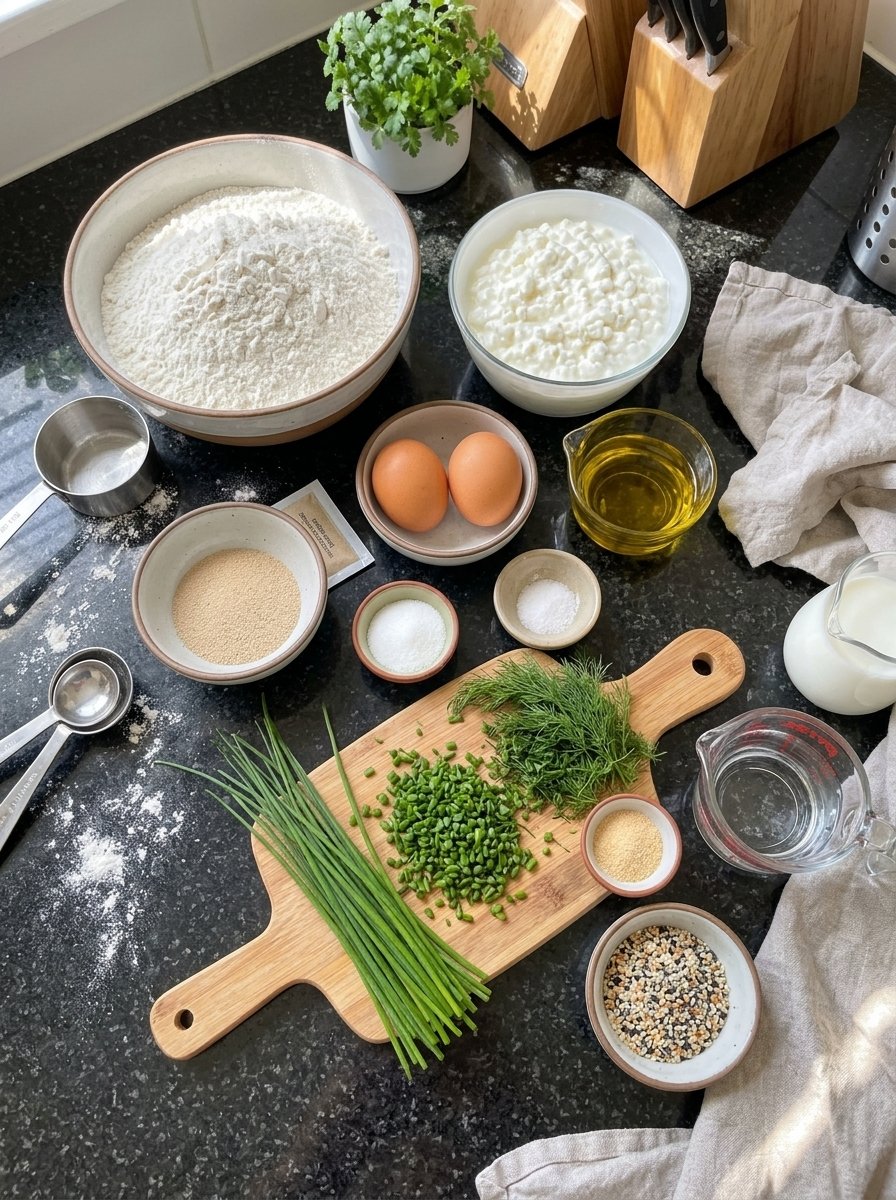
Here is everything you need for one 9 × 5-inch loaf:
- 3⅓ cups bread flour (400 g), spooned and leveled
- 1 cup cottage cheese (225 g)
- 2 large eggs, room temperature
- 2¼ teaspoons instant yeast (7 g)
- 2 tablespoons olive oil (30 ml)
- 1 tablespoon granulated sugar (12 g)
- 1 teaspoon salt (6 g)
- 2 tablespoons fresh chives, finely chopped
- 1 tablespoon fresh dill, finely chopped
- 1 teaspoon garlic powder
- 2–4 tablespoons warm water, as needed
- 1 tablespoon milk or beaten egg, for brushing (optional)
- 1 teaspoon sesame seeds or everything bagel seasoning, for topping (optional)
Ingredient Notes and Smart Substitutions
Bread flour. Bread flour is the best choice here because its higher protein content builds a stronger gluten network, which means a chewier, taller loaf. If you only have all-purpose flour, you can still bake the bread, but expect a slightly softer, less chewy texture and possibly a little more stickiness in the dough.
Cottage cheese. Small-curd cottage cheese blends easily, and full-fat or low-fat versions both work. Full-fat gives the richest flavor and softest crumb, while low-fat keeps things lighter. Because brands vary in moisture, you may need to adjust the water. If your cottage cheese is very wet, pour off any excess liquid before blending.
Eggs. Room-temperature eggs blend more easily into the cottage cheese mixture and help the yeast stay happy. If you forget to take them out ahead of time, place them in a bowl of warm tap water for five minutes.
Instant yeast. Instant yeast can be mixed right into the dry ingredients. If you only have active dry yeast, dissolve it in a few tablespoons of the warm water first and allow it to foam for about five to ten minutes before adding it to the wet ingredients. Expect the rise to take a little longer.
Fresh herbs. Fresh chives and dill are what give this loaf its signature taste. Chop them finely so they distribute evenly and do not tear the dough. If you must use dried dill, start with about one teaspoon, since dried herbs are more concentrated, and skip dried chives if possible as they lose most of their flavor.
Olive oil. A mild olive oil adds tenderness without overpowering the herbs. Melted butter is a good alternative if you prefer a richer flavor.
Toppings. Everything bagel seasoning is the obvious choice, but sesame seeds, poppy seeds or a sprinkle of extra chopped herbs all look beautiful on the golden crust.
Equipment You Will Need
- Blender or food processor (for smoothing the cottage cheese)
- Two large mixing bowls, or a stand mixer with a dough hook
- Wooden spoon or spatula
- 9 × 5-inch loaf pan
- Parchment paper (optional, for easy removal)
- Pastry brush (optional)
- Wire cooling rack
- Serrated bread knife
- Instant-read thermometer (optional but very helpful)
How to Make Cottage Cheese Chive Dill Bagel Bread, Step by Step
Total time: approximately 3 to 4 hours, most of which is hands-off rising and cooling time.
Step 1: Blend the Cottage Cheese
Add the cottage cheese to a blender or food processor and blend until completely smooth and creamy. This is a small step that makes a big difference. Blending prevents large curds from creating uneven pockets in the finished bread and gives you a uniform, tender crumb.
Step 2: Mix the Wet Ingredients
In a large mixing bowl, combine the blended cottage cheese, eggs, olive oil and sugar. Whisk until the mixture is smooth and evenly combined. The sugar gives the yeast a little food and adds a hint of sweetness that balances the savory herbs.
Step 3: Combine the Dry Ingredients
In a separate bowl, whisk together the bread flour, instant yeast, salt and garlic powder. Add the chopped chives and dill and toss gently so the herbs are coated in flour and distributed throughout. Coating the herbs this way helps keep them from clumping.
Step 4: Form the Dough
Gradually add the dry ingredients to the cottage cheese mixture. Stir with a wooden spoon, or use a stand mixer fitted with a dough hook, until a rough dough forms.
Now check the consistency. If the dough feels too dry or stiff, add warm water one tablespoon at a time, up to four tablespoons. You are aiming for a dough that is soft and slightly tacky without being excessively sticky. Remember that cottage cheese brands vary in moisture, so it is better to add water gradually than all at once.
Step 5: Knead Until Smooth
Transfer the dough to a lightly floured work surface and knead for 8 to 10 minutes by hand, or use a stand mixer on medium-low speed for about 6 to 8 minutes. The dough should become smooth, elastic and easy to handle.
Try to resist adding too much extra flour. It is tempting when the dough sticks to your hands, but excess flour can make the finished loaf dense and dry. A lightly floured surface and slightly damp hands are usually enough.
The windowpane test: To check whether the gluten is developed, pinch off a small piece of dough and gently stretch it. If it stretches thin enough to let light pass through without tearing right away, you have kneaded it enough.
Step 6: Let the Dough Rise (First Rise)
Place the dough in a lightly greased bowl and turn it once to coat the surface. Cover with a clean kitchen towel or plastic wrap. Let it rise in a warm place for about 60 to 90 minutes, or until doubled in size. The exact time depends on the temperature of your kitchen. A warmer room speeds things up, while a cool one slows things down.
Step 7: Shape the Loaf
Gently press the dough to release the excess air. Transfer it to a lightly floured surface and shape it into a smooth loaf. To do this, pat the dough into a rectangle, roll it up snugly from the short side, pinch the seam closed and tuck the ends under.
Place the shaped dough, seam side down, into a greased 9 × 5-inch loaf pan, lined with parchment paper if you like. Gently smooth the surface so the loaf rises evenly.
Step 8: Complete the Second Rise
Cover the loaf loosely and let it rise for another 30 to 45 minutes, until it looks noticeably puffy and has risen close to the top of the pan. Toward the end of the rising time, preheat your oven to 350°F (175°C).
The poke test: Lightly press a floured finger into the dough. If the indentation springs back slowly and only partly, the loaf is ready. If it springs back immediately, give it a little more time. If it does not spring back at all, bake it right away.
Step 9: Add the Topping
If you like, gently brush the surface with milk or beaten egg for a more golden, glossy crust. Sprinkle sesame seeds or everything bagel seasoning over the top. Brushing first helps the toppings stick.
Step 10: Bake Until Golden
Place the loaf in the preheated oven and bake for 35 to 45 minutes, until the top is golden brown and the loaf is cooked through. If the top browns too quickly, loosely cover it with foil for the final part of baking.
For the most reliable doneness check, use an instant-read thermometer. The center of the loaf should reach roughly 190 to 200°F (88 to 93°C). The bread should also sound hollow when you tap the bottom.
Step 11: Cool and Slice
Remove the bread from the oven and let it rest in the pan for about 10 minutes. Carefully transfer it to a wire rack and let it cool completely before slicing. This step matters more than most people realize. Slicing too early releases steam and can leave the crumb gummy, while a fully cooled loaf slices cleanly and has a better texture.
Use a serrated bread knife and a gentle sawing motion to cut even slices. Toasting the slices lightly brings out the savory herbs and the chewy, bagel-like texture.
Step 12: Serve and Enjoy
Serve the bread plain, toasted with butter or spread with cream cheese. It is just as good as the base for egg sandwiches, open-faced lunches and savory snacks.
Recipe at a Glance
- Prep time: 25 minutes
- First rise: 60–90 minutes
- Second rise: 30–45 minutes
- Bake time: 35–45 minutes
- Cooling time: 30–45 minutes
- Total time: approximately 3–4 hours
- Yield: 1 loaf, about 10–12 slices
- Oven temperature: 350°F (175°C)
Expert Tips for the Best Cottage Cheese Bagel Bread
Blend until truly smooth. Even small curds can leave visible spots and uneven texture. A minute or two in a blender gives a silky base.
Add water slowly. Cottage cheese varies widely in moisture. Start with the lowest amount of water and add more only when the dough feels stiff.
Do not skip the kneading. Kneading is what creates the chewy, bagel-inspired texture. Underkneaded dough tends to bake into a crumbly, less structured loaf.
Watch the dough, not the clock. Rise times are estimates. Look for a dough that has doubled in size the first time and looks puffy and airy the second time.
Use fresh herbs and chop them finely. Large pieces of herb can weigh down the dough and cause uneven distribution. Fine chopping spreads the flavor evenly.
Tent with foil if needed. Because the dough contains eggs, dairy and a little sugar, the top can brown quickly. A loose foil tent in the last 10 to 15 minutes protects the crust.
Let it cool completely. Patience pays off with cleaner slices and a better crumb.
Troubleshooting: Common Problems and Fixes
My dough is too sticky. Cottage cheese can add extra moisture. Knead a little longer first, since dough often becomes less sticky as gluten develops. If it is still unmanageable, add flour one tablespoon at a time, using as little as possible.
My dough is too dry or stiff. Add warm water one tablespoon at a time and knead until the dough feels soft and slightly tacky.
The bread did not rise well. Check that your yeast is fresh and not expired. Make sure the water was warm, not hot, since hot liquid can kill yeast. Also give the dough a warm, draft-free place to rise, such as an oven with only the light on.
The loaf is dense. Common causes are adding too much flour, underkneading, or baking before the second rise is complete. Measure the flour by spooning it into the cup and leveling it, or better yet, weigh it.
The top browned too quickly. Cover loosely with foil and continue baking. Check that your oven temperature is accurate, since many ovens run hot.
The center is gummy. The loaf may need more baking time, or it may have been sliced while still warm. Use a thermometer to confirm it has reached the right internal temperature, and let it cool completely.
Creative Variations
Once you have mastered the base recipe, try these ideas:
- Everything bagel loaf. Press a generous layer of everything bagel seasoning onto the egg-brushed top, and add a little more inside the dough for extra flavor.
- Cheesy herb loaf. Fold in half a cup of shredded cheddar, Gruyère or Parmesan for a cheese-and-herb version.
- Jalapeño cheddar twist. Add finely diced jalapeño and sharp cheddar and omit the dill for a spicy-savory option.
- Everything-but-dill. Swap the dill for fresh parsley or green onions if dill is not your favorite.
- Seeded crust. Combine sesame, poppy and sunflower seeds for a bakery-style crust.
- Dinner rolls. Divide the dough into 10 to 12 pieces after the first rise, shape into rolls, let them rise, and bake for about 20 to 25 minutes, until golden.
- Mini loaves. Use smaller pans and shorten the bake time, checking for doneness with a thermometer.
What to Serve with Cottage Cheese Chive Dill Bagel Bread
This bread is far more than a breakfast loaf. Here are some of the best ways to enjoy it:
Herbed cream cheese toast. Spread toasted slices with cream cheese and sprinkle with extra fresh chives. It is simple, but it tastes like a bagel shop special.
Breakfast sandwich. Layer scrambled eggs, sliced cheese and avocado between two slices for a hearty morning meal.
Smoked salmon toast. Top with cream cheese, smoked salmon, fresh dill and a squeeze of lemon. The dill in the bread echoes the topping beautifully.
Avocado toast. Spread with mashed avocado, black pepper and a splash of lemon juice for a quick lunch or snack.
Soup companion. Serve alongside creamy tomato soup, vegetable soup or chicken soup. The savory herbs complement almost any broth or purée.
Savory sandwiches. Use it for turkey, chicken, egg salad or roasted vegetable sandwiches. The sturdy, chewy crumb holds up well to fillings.
Open-faced lunch. Top a toasted slice with tomato, cucumber, a soft egg and a drizzle of olive oil.
How to Store Cottage Cheese Bread
Because this loaf contains cottage cheese and eggs, storage matters for both quality and food safety.
Refrigerator: Allow the bread to cool completely, then store it in an airtight container in the refrigerator for up to 4 days.
Freezer: Slice the cooled loaf and place parchment paper between the slices so they do not stick together. Freeze in a freezer-safe bag for up to 2 months.
Reheating: Toast refrigerated or frozen slices until warm and lightly crisp around the edges. You can toast frozen slices straight from the freezer, with no thawing needed.
Meal prep: Slice the loaf once it has cooled and portion it out for easy breakfasts, sandwiches and snacks throughout the week. It is a convenient way to have homemade bread ready on busy mornings.
Is Cottage Cheese Bagel Bread Healthy?
This loaf is a good option if you want a bread with more protein than a standard sandwich loaf. Cottage cheese and eggs both provide protein, and the bread is made with simple, familiar ingredients. Fresh herbs add flavor without extra calories, and olive oil contributes a modest amount of unsaturated fat.
That said, it is still a yeast bread made with refined bread flour, so it is best enjoyed as part of a balanced diet. Pair a slice with eggs, avocado or smoked salmon for a satisfying, protein-rich meal. If you track nutrition closely, the exact numbers will depend on the brand of cottage cheese you use and the size of your slices, so use a nutrition calculator with your specific ingredients for accurate values.
Frequently Asked Questions
Can I make this bread without a stand mixer?
Yes. You can mix the dough with a wooden spoon and knead it by hand for 8 to 10 minutes. It takes a little more effort, but the results are just as good.
Do I have to blend the cottage cheese?
Blending is strongly recommended. It creates a smooth, even crumb and prevents large curds from leaving uneven texture in the bread.
Can I use low-fat or fat-free cottage cheese?
Yes, though full-fat or low-fat cottage cheese will generally give a softer, richer result. Fat-free versions can be a bit wetter, so add water cautiously.
Can I use dried herbs instead of fresh?
Fresh chives and dill give the best flavor. If you must use dried dill, use about 1 teaspoon. Dried chives are far less flavorful, so fresh is worth seeking out.
Can I use all-purpose flour instead of bread flour?
Yes, but the loaf will be a little softer and less chewy. Bread flour is recommended for the classic bagel-like texture.
Why is my dough sticky?
Cottage cheese moisture levels vary. Knead for the full time before adding any more flour, and add flour sparingly if needed.
How do I know when the bread is fully baked?
The top should be deep golden brown, the bottom should sound hollow when tapped, and the center should reach about 190 to 200°F (88 to 93°C).
Can I freeze the dough?
This recipe was developed for baking the loaf, so the best-tested approach is to freeze the baked, sliced bread. If you want to experiment with freezing dough, shape it first, freeze it, then thaw and complete the second rise before baking, keeping in mind that results may vary.
Can I make this recipe dairy-free?
The cottage cheese is central to the texture and protein content, so this recipe is not designed for dairy-free baking.
Can I bake this in a different pan?
A 9 × 5-inch loaf pan is recommended. You can also shape the dough into rolls or a free-form loaf, adjusting the baking time and checking for doneness with a thermometer.
How long does the bread stay fresh?
Stored in an airtight container in the refrigerator, it keeps for up to 4 days. For longer storage, freeze slices for up to 2 months.
Final Thoughts
This High-Protein Cottage Cheese Chive Dill Bagel Bread proves that homemade bread can be wholesome, flavorful and wonderfully easy to work with. Blended cottage cheese brings moisture and protein, bread flour provides that signature chew, and fresh chives, dill and garlic make every slice taste like a trip to your favorite bagel shop, without the boiling and shaping.
Bake a loaf this weekend, slice it once it has cooled, and toast a few pieces with cream cheese. Then freeze the rest so you have savory, herby, protein-packed bread ready all week long. Once you try it, it will likely become a staple in your kitchen.
Print
High-Protein Cottage Cheese Chive Dill Bagel Bread
Ingredients
Here is everything you need for one 9 × 5-inch loaf:
- 3⅓ cups bread flour (400 g), spooned and leveled
- 1 cup cottage cheese (225 g)
- 2 large eggs, room temperature
- 2¼ teaspoons instant yeast (7 g)
- 2 tablespoons olive oil (30 ml)
- 1 tablespoon granulated sugar (12 g)
- 1 teaspoon salt (6 g)
- 2 tablespoons fresh chives, finely chopped
- 1 tablespoon fresh dill, finely chopped
- 1 teaspoon garlic powder
- 2–4 tablespoons warm water, as needed
- 1 tablespoon milk or beaten egg, for brushing (optional)
- 1 teaspoon sesame seeds or everything bagel seasoning, for topping (optional)
Ingredient Notes and Smart Substitutions
Bread flour. Bread flour is the best choice here because its higher protein content builds a stronger gluten network, which means a chewier, taller loaf. If you only have all-purpose flour, you can still bake the bread, but expect a slightly softer, less chewy texture and possibly a little more stickiness in the dough.
Cottage cheese. Small-curd cottage cheese blends easily, and full-fat or low-fat versions both work. Full-fat gives the richest flavor and softest crumb, while low-fat keeps things lighter. Because brands vary in moisture, you may need to adjust the water. If your cottage cheese is very wet, pour off any excess liquid before blending.
Eggs. Room-temperature eggs blend more easily into the cottage cheese mixture and help the yeast stay happy. If you forget to take them out ahead of time, place them in a bowl of warm tap water for five minutes.
Instant yeast. Instant yeast can be mixed right into the dry ingredients. If you only have active dry yeast, dissolve it in a few tablespoons of the warm water first and allow it to foam for about five to ten minutes before adding it to the wet ingredients. Expect the rise to take a little longer.
Fresh herbs. Fresh chives and dill are what give this loaf its signature taste. Chop them finely so they distribute evenly and do not tear the dough. If you must use dried dill, start with about one teaspoon, since dried herbs are more concentrated, and skip dried chives if possible as they lose most of their flavor.
Olive oil. A mild olive oil adds tenderness without overpowering the herbs. Melted butter is a good alternative if you prefer a richer flavor.
Toppings. Everything bagel seasoning is the obvious choice, but sesame seeds, poppy seeds or a sprinkle of extra chopped herbs all look beautiful on the golden crust.
Instructions
Total time: approximately 3 to 4 hours, most of which is hands-off rising and cooling time.
Add the cottage cheese to a blender or food processor and blend until completely smooth and creamy. This is a small step that makes a big difference. Blending prevents large curds from creating uneven pockets in the finished bread and gives you a uniform, tender crumb.
In a large mixing bowl, combine the blended cottage cheese, eggs, olive oil and sugar. Whisk until the mixture is smooth and evenly combined. The sugar gives the yeast a little food and adds a hint of sweetness that balances the savory herbs.
In a separate bowl, whisk together the bread flour, instant yeast, salt and garlic powder. Add the chopped chives and dill and toss gently so the herbs are coated in flour and distributed throughout. Coating the herbs this way helps keep them from clumping.
Gradually add the dry ingredients to the cottage cheese mixture. Stir with a wooden spoon, or use a stand mixer fitted with a dough hook, until a rough dough forms.
Now check the consistency. If the dough feels too dry or stiff, add warm water one tablespoon at a time, up to four tablespoons. You are aiming for a dough that is soft and slightly tacky without being excessively sticky. Remember that cottage cheese brands vary in moisture, so it is better to add water gradually than all at once.
Transfer the dough to a lightly floured work surface and knead for 8 to 10 minutes by hand, or use a stand mixer on medium-low speed for about 6 to 8 minutes. The dough should become smooth, elastic and easy to handle.
Try to resist adding too much extra flour. It is tempting when the dough sticks to your hands, but excess flour can make the finished loaf dense and dry. A lightly floured surface and slightly damp hands are usually enough.
The windowpane test: To check whether the gluten is developed, pinch off a small piece of dough and gently stretch it. If it stretches thin enough to let light pass through without tearing right away, you have kneaded it enough.
Place the dough in a lightly greased bowl and turn it once to coat the surface. Cover with a clean kitchen towel or plastic wrap. Let it rise in a warm place for about 60 to 90 minutes, or until doubled in size. The exact time depends on the temperature of your kitchen. A warmer room speeds things up, while a cool one slows things down.
Gently press the dough to release the excess air. Transfer it to a lightly floured surface and shape it into a smooth loaf. To do this, pat the dough into a rectangle, roll it up snugly from the short side, pinch the seam closed and tuck the ends under.
Place the shaped dough, seam side down, into a greased 9 × 5-inch loaf pan, lined with parchment paper if you like. Gently smooth the surface so the loaf rises evenly.
Cover the loaf loosely and let it rise for another 30 to 45 minutes, until it looks noticeably puffy and has risen close to the top of the pan. Toward the end of the rising time, preheat your oven to 350°F (175°C).
The poke test: Lightly press a floured finger into the dough. If the indentation springs back slowly and only partly, the loaf is ready. If it springs back immediately, give it a little more time. If it does not spring back at all, bake it right away.
If you like, gently brush the surface with milk or beaten egg for a more golden, glossy crust. Sprinkle sesame seeds or everything bagel seasoning over the top. Brushing first helps the toppings stick.
Place the loaf in the preheated oven and bake for 35 to 45 minutes, until the top is golden brown and the loaf is cooked through. If the top browns too quickly, loosely cover it with foil for the final part of baking.
For the most reliable doneness check, use an instant-read thermometer. The center of the loaf should reach roughly 190 to 200°F (88 to 93°C). The bread should also sound hollow when you tap the bottom.
Remove the bread from the oven and let it rest in the pan for about 10 minutes. Carefully transfer it to a wire rack and let it cool completely before slicing. This step matters more than most people realize. Slicing too early releases steam and can leave the crumb gummy, while a fully cooled loaf slices cleanly and has a better texture.
Use a serrated bread knife and a gentle sawing motion to cut even slices. Toasting the slices lightly brings out the savory herbs and the chewy, bagel-like texture.
Serve the bread plain, toasted with butter or spread with cream cheese. It is just as good as the base for egg sandwiches, open-faced lunches and savory snacks.