Ingredients
Understanding why each ingredient matters will help you get the best possible results — and gives you the confidence to make smart substitutions if needed.
Cottage Cheese
Cottage cheese is the star of this recipe. It adds moisture, a subtle tang, and a significant protein punch while keeping the crumb soft and tender. If your cottage cheese is particularly watery, draining it briefly before measuring will help prevent a soggy loaf. For an ultra-smooth texture with no visible curds, you can blend the cottage cheese before mixing it into the batter.
Eggs
Two large eggs provide structure, richness, and additional protein. They also help bind the batter together, giving the finished loaf a tender, cake-like crumb rather than a dense, gummy texture.
Self-Rising Flour
Self-rising flour is the secret to skipping yeast entirely. Because it already contains baking powder and salt, it gives the bread lift and a soft, airy structure without any proofing time. This is what transforms the recipe from an all-day bagel-making project into a 15-minute prep, one-bowl bake.
Parmesan and Mozzarella Cheese
This dynamic cheese duo does double duty. Parmesan brings a sharp, salty, umami-rich flavor that deepens the overall taste of the bread, while mozzarella melts into gooey pockets throughout the loaf, giving every bite that irresistible cheesy pull. Using freshly grated and shredded cheese (rather than pre-shredded, anti-caking-coated varieties) will give you the best melt and flavor.
Onion
Fresh yellow onion, finely diced and lightly sautéed, is what gives this bread its signature savory backbone. Cooking the onion first softens its sharp bite and brings out a subtle natural sweetness, while ensuring it cooks through fully during baking.
Garlic Powder, Dried Parsley, and Dried Onion Flakes
This seasoning trio is what ties everything together into that classic “everything bagel meets onion bagel” flavor profile. The dried onion flakes in particular intensify the onion flavor without adding extra moisture, and they can be increased for an even bolder taste.
Salt
A modest amount of salt balances the richness of the cheese and rounds out all the savory flavors in the loaf.
Instructions
Start by finely dicing half a medium yellow onion into small, even pieces — the smaller and more uniform the dice, the more evenly the onion will distribute throughout the batter and cook through during baking. Heat a small skillet over medium heat and sauté the onion for 3 to 5 minutes, stirring occasionally, until it softens and turns lightly golden. Remove it from the heat and let it cool slightly before adding it to the batter. This quick pre-cooking step is essential — it mellows the onion’s raw sharpness and ensures it doesn’t remain crunchy or undercooked in the finished loaf.
While the onion cools, preheat your oven to 375°F (190°C). In a large mixing bowl, combine the cottage cheese and eggs, stirring until the mixture is smooth and well blended. If you prefer a completely smooth batter with no visible curds, pulse the cottage cheese and eggs together in a blender before transferring the mixture to your mixing bowl.
To the cottage cheese mixture, add the grated Parmesan, shredded mozzarella, garlic powder, dried parsley, dried onion flakes, and salt. Stir everything together until the cheeses and seasonings are evenly incorporated. Then fold in your cooled, sautéed onion, distributing it evenly throughout the mixture.
Add the self-rising flour to the bowl and stir gently with a spatula just until a thick, soft dough forms. This is a key moment in the recipe: overmixing at this stage can lead to a dense, tough loaf, so stir only until the flour disappears and no dry pockets remain. A few gentle folds are all it takes.
Lightly grease an 8×4-inch loaf pan, or line it with parchment paper for easy removal later. Transfer the thick dough into the prepared pan, using a spatula to gently press and smooth the top so the batter is evenly distributed from edge to edge.
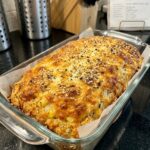
Place the loaf pan in your preheated oven and bake for 35 to 45 minutes. You’re looking for a deep golden-brown top and a center that feels fully set when gently pressed. To check doneness, insert a toothpick into the center of the loaf — it should come out mostly clean, though a little melted cheese clinging to it is completely normal and not a sign of underbaking. If the top begins to brown too quickly before the center finishes cooking, loosely tent the loaf with foil for the remainder of the bake time.
Once baked, remove the loaf from the oven and let it rest in the pan for 10 to 15 minutes. This resting period allows the structure to firm up, making it much easier to remove without falling apart. Carefully transfer the loaf to a wire cooling rack and let it cool further before slicing. Patience here really does pay off — slicing too early can result in a gummy, underset crumb, even if the bread is fully baked. Use a sharp serrated knife for clean, even slices.