Ingredients
- 500 g bread flour
- 350 g water, at room temperature
- 100 g active sourdough starter, at 100% hydration
- 10 g salt
Instructions
In a large bowl, combine the water and active sourdough starter, stirring until the starter mostly dissolves. Add the bread flour and mix with your hand or a spatula until no dry flour remains. The dough will look rough and shaggy. Cover the bowl and let it rest for 30 minutes. This rest, often called an autolyse, allows the flour to hydrate fully and makes the dough smoother and easier to handle.
Sprinkle the salt over the dough and work it in with damp hands until evenly incorporated. You can squeeze and pinch the dough, folding it over itself. Wet hands help prevent sticking.
Cover the bowl and let the dough ferment at room temperature for about 4 to 6 hours. The exact time depends on the strength of your starter and the temperature of your kitchen. A warm kitchen speeds things up, and a cool one slows things down.
During the first 2 hours of bulk fermentation, perform 3 to 4 sets of stretch-and-folds, spaced about 30 minutes apart. To do a set, wet your hand, grab one side of the dough, lift and gently stretch it upward, then fold it over the center. Rotate the bowl and repeat around the dough, usually four times. Each set takes less than a minute.
These folds build strength and structure, trapping gas and creating an airy crumb. After the last set, let the dough rest undisturbed for the remainder of the bulk fermentation.
The dough is ready when it looks smoother, feels airy and has increased noticeably in volume. You should see bubbles on the surface and along the sides of the bowl, and the dough should jiggle when you shake the bowl. A volume increase of around 50% to 75% is a common target, though the visual and tactile signs matter more than a number. If your kitchen is cool, it may need more time. Avoid overfermenting, which can make the dough slack and sticky.
Turn the dough onto a lightly floured surface. Gently shape it into a round or oval loaf (boule or batard), creating surface tension without pressing out too much air. To shape, fold the edges toward the center, flip the dough over and use your hands or a bench scraper to drag it gently toward you, tightening the surface. The goal is a taut skin that holds the loaf’s shape.
Place the dough seam-side up in a floured proofing basket or a towel-lined bowl. Use rice flour or a mix of flour to prevent sticking. Cover and refrigerate for 8 to 16 hours. The cold slows fermentation, deepens flavor and makes the dough easier to score. If you prefer a quicker version, you can proof at room temperature for 1 to 2 hours, but the flavor and handling will be different.
Place a Dutch oven with its lid inside the oven and preheat to 245°C (475°F) for at least 30 minutes. A very hot Dutch oven is key to a great crust and oven spring.
If you do not have a Dutch oven, use a baking stone or heavy tray and a separate oven-safe pan on the lower rack. When you load the bread, pour hot water into the pan to create steam, and be careful of the hot steam.
Carefully turn the dough onto parchment paper and make one confident slash across the top with a sharp bread lame, razor blade or knife. Scoring controls where the loaf expands, preventing random bursts and creating an attractive pattern. A decisive cut about 1 cm deep works well.
Using the parchment as a sling, carefully transfer the loaf into the hot Dutch oven, cover with the lid and bake for 20 minutes. The trapped steam keeps the crust soft at first, allowing the loaf to expand fully. Remove the lid, reduce the temperature to 230°C (450°F) and bake for another 15 to 25 minutes, until deeply golden and crisp. The internal temperature should reach about 96°C to 99°C (205°F to 210°F).
Always use thick oven mitts. The Dutch oven and lid are extremely hot.
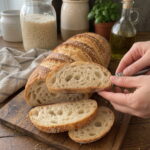
Transfer the bread to a wire rack and let it cool for at least 1 hour before slicing. This helps the crumb finish setting and preserves the airy texture. As the loaf cools, you may hear the crust crackling, often called singing. It is a good sign.