Ingredients
Here is everything you need to make one standard loaf, which yields about 10 to 12 slices:
- 3 cups (375 g) all-purpose flour or bread flour
- 1 cup (240 ml) warm milk, about 100–110°F (38–43°C)
- 2¼ teaspoons (7 g) instant yeast
- 3 tablespoons (38 g) granulated sugar
- 1 teaspoon (6 g) salt
- 4 tablespoons (56 g) unsalted butter, melted and slightly cooled
- 1 large egg, at room temperature
- 1 tablespoon milk or melted butter, for brushing the top (optional)
Ingredient Notes and Substitutions
Flour. All-purpose flour gives a soft, tender loaf, while bread flour has more protein and produces a slightly chewier, more structured crumb. Either one works beautifully, so use what you have on hand. For the most accurate results, weigh your flour with a kitchen scale.
Milk. Whole milk gives the richest flavor and softest texture, but 2% milk also works. In a pinch, you can use a plant-based milk, though the crumb may be a little less rich. Make sure it is warm, not hot.
Yeast. This recipe uses instant yeast, which can be mixed directly into the wet ingredients. If you only have active dry yeast, you can use the same amount, but allow it to sit in the warm milk and sugar for about 5 to 10 minutes until foamy before adding the other ingredients. Expect the rise to take a little longer.
Sugar. Sugar feeds the yeast and adds a gentle sweetness. Granulated sugar is ideal, but you can substitute the same amount of honey or caster sugar.
Butter. Unsalted butter lets you control the salt level. If you only have salted butter, reduce the added salt slightly. Let the melted butter cool a bit so it does not scramble the egg or harm the yeast.
Egg. The egg adds richness, color, and structure. Use it at room temperature so it blends smoothly into the dough.
Instructions
Follow these ten simple steps for a perfect loaf every time.
In a large mixing bowl, combine the warm milk, granulated sugar, and instant yeast. Stir gently until the sugar dissolves. Add the melted butter and the egg, then whisk until everything is well combined and the mixture looks smooth and uniform.
Add the flour and salt to the wet ingredients. Stir with a wooden spoon or sturdy spatula until no dry flour remains. The dough should look soft, sticky, and slightly shaggy. This is exactly right. You do not need to knead it or bring out a stand mixer.
Cover the bowl with plastic wrap or a clean kitchen towel. Place it in a warm, draft-free spot for about 60 to 90 minutes, or until the dough has doubled in size. A cooler kitchen may need extra time. An oven with only the light turned on is a handy warm spot for rising dough.
Lightly grease a standard 9 × 5-inch (23 × 13 cm) loaf pan with butter or cooking spray. Once the dough has risen, gently stir it with a spatula to release some of the larger air pockets. This helps create an even, fine crumb.
Lightly grease your hands or your spatula so the sticky dough is easier to handle. Transfer the dough into the prepared pan and gently spread it toward the corners. Smooth the top as evenly as possible so the loaf bakes with an attractive, level dome.
Cover the pan loosely and let the dough rise for another 30 to 45 minutes, or until it looks puffy and has risen noticeably above its original level. Try not to let it overproof, because an overproofed loaf can collapse in the oven.
Toward the end of the second rise, preheat your oven to 350°F (175°C). If you like, gently brush the top of the dough with a little milk to encourage a lightly golden crust.
Bake for 30 to 35 minutes, until the top is golden brown and the loaf is cooked through. If the top browns too quickly, loosely cover it with aluminum foil for the remaining time. For perfect doneness, the center should reach about 190–200°F (88–93°C) when checked with an instant-read thermometer.
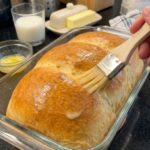
Remove the loaf from the oven and let it rest in the pan for about 10 minutes. Carefully transfer it to a wire rack. For an extra-soft crust, brush the top with melted butter while the bread is still warm. Allow it to cool for at least 30 to 45 minutes before slicing so the crumb can set properly.
Use a serrated knife to slice the bread with a gentle sawing motion. Serve it warm with butter, jam, or honey, or use it to build your favorite sandwiches.