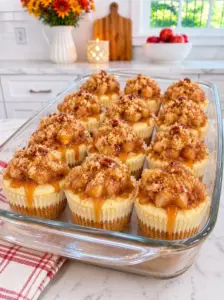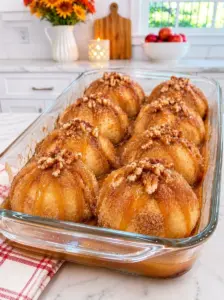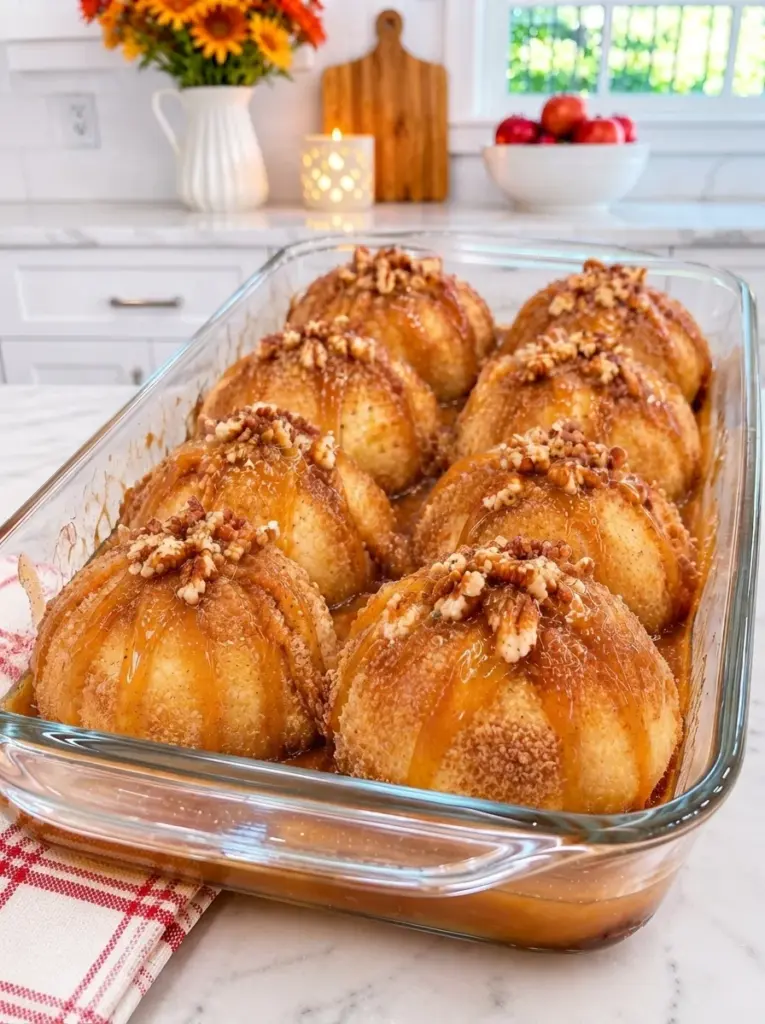
Caramel Apple Dumpling Bombs wrap a small spoonful of cinnamon apples and a soft caramel candy inside refrigerated biscuit dough. The parcels bake into golden, tender buns, then receive a brushed-butter finish and a dusting of cinnamon sugar. Warm caramel sauce makes an optional final drizzle.
They offer the flavor of an apple-and-caramel dessert without making pastry from scratch. The biscuit wrapper is soft and bread-like rather than flaky like pie crust, and the apple filling is cooked before assembly so the little diced pieces become tender during the relatively short bake.
The most useful preparation steps are cooling the filling, keeping the dough edges clean, and resisting the urge to overfill. A sealed parcel needs enough dough around the center to hold its shape and bake through. The caramel also needs time to cool after baking before anyone bites into it.
This article expands the supplied recipe with assembly, timing, and storage guidance. It has not been independently kitchen-tested. Biscuit brands, candy size, apple moisture, and pan choice can change the result, so use the doneness checks alongside the estimated times.
What to Expect
The finished dumplings should have a golden biscuit exterior, tender dough inside, and a small apple-caramel pocket. They are individual filled buns rather than steamed dumplings or classic pastry-wrapped whole apples.
Soft caramel can melt into a rich center while baking, but it may firm somewhat as the dumplings cool. Different candies have different textures, so a permanently flowing center is not guaranteed.
A few small leaks are possible even with careful sealing. A parchment-lined rimmed baking sheet helps contain them, and a little leaked caramel does not necessarily ruin the whole batch. Large splits, however, often indicate overfilling or a weak seam.
The cinnamon-sugar finish is a coating, not a crisp candy shell. It clings best when the warm buns are brushed lightly with butter.
Ingredients
Apple Filling
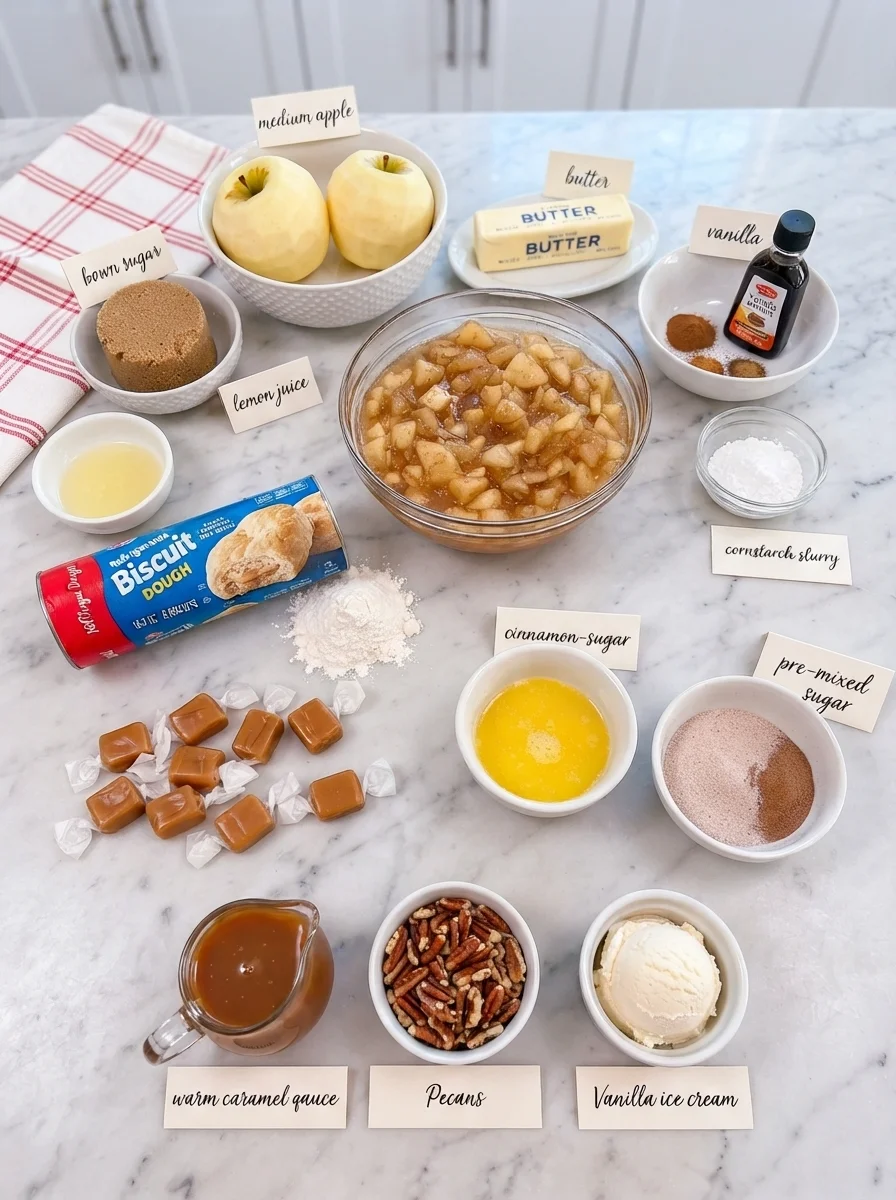
- 2 medium apples, peeled, cored, and finely diced
- 2 tablespoons unsalted butter
- 1/4 cup packed brown sugar
- 1 teaspoon ground cinnamon
- 1/4 teaspoon ground nutmeg
- 1/2 teaspoon vanilla extract
- 1 teaspoon lemon juice
- 1 teaspoon cornstarch
- 1 teaspoon water, for the cornstarch slurry
Biscuit Parcels
- 1 can refrigerated biscuit dough, 16.3 ounces, containing 8 biscuits
- 8 small soft caramel candies, unwrapped
- Up to 1 tablespoon all-purpose flour, for dusting if needed
Cinnamon-Sugar Finish
- 3 tablespoons unsalted butter, melted
- 1/4 cup granulated sugar
- 1 teaspoon ground cinnamon
Serving
- Up to 1/4 cup caramel sauce, warmed
- Chopped pecans or walnuts, optional
- Vanilla ice cream, optional
Yield: Eight filled biscuit dumplings.
The filling recipe may produce more than the eight tablespoons needed for assembly. Use roughly one tablespoon per biscuit and keep any extra separately. Do not force the entire skillet of apples into the parcels simply to avoid leftovers.
Ingredient Notes
Dice the apples finely
Small, evenly sized pieces soften quickly and are easier to enclose than large chunks. Aim for approximately 1/4-inch dice rather than long slices.
Choose firm apples you enjoy cooked, such as Honeycrisp, Fuji, or Granny Smith. A tart apple gives more contrast to the caramel; a sweeter apple produces a sweeter overall dessert.
Apple size varies substantially. Two very large apples can produce far more filling than the biscuits can hold. Portion by the spoonful during assembly, not by dividing all available filling automatically.
Cook the filling until tender and cohesive
The skillet stage should soften the diced apples and reduce loose moisture. The cornstarch thickens the released juices so they stay with the fruit rather than soaking the dough.
If the apples are still quite hard after the initial four to five minutes, continue gently until they are approaching tenderness before adding the slurry. The closed biscuit parcel is not the place to rely on large raw pieces finishing perfectly.
The mixture should be glossy and spoonable, not watery. Let it cool before deciding whether the consistency is appropriate for filling.
Use a large-biscuit product
The supplied 16.3-ounce can with eight biscuits is a reference for relatively large individual biscuits. Smaller biscuits will not hold the same amount of filling.
Check the package temperature and baking directions. The stated 350°F is appropriate as a starting point only when compatible with your product. Stuffing the dough can require more time than baking the biscuits plain.
Flaky-layer and homestyle biscuits may seal and expand differently. Keep the dough cold until assembly and avoid separating internal layers unnecessarily.
Choose soft caramel candies
Use small, soft caramels intended to be chewed rather than hard caramel sweets. Hard candy is not a direct replacement and can remain unpleasantly hard or behave differently in the filling.
If a caramel is much larger than the opening in the dough, cut it into smaller pieces while keeping the total modest. A large candy can push against the seam and increase the chance of leakage.
Remove every wrapper before beginning assembly. Keep the candies ready so the dough does not sit warm while you unwrap them one at a time.
The coating and drizzle are separate
The melted butter helps cinnamon sugar adhere. Brush lightly rather than soaking the baked buns.
The caramel sauce is added after baking. It is not needed inside the dough because the soft candy already supplies a caramel component.
Optional nuts and ice cream change both the serving style and nutrition. Keep them separate until serving if you expect leftovers.
Equipment
Use a skillet, a small bowl for the slurry, a mixing bowl for cinnamon sugar, a pastry brush, and a rimmed baking sheet lined with parchment rated for the baking temperature.
A baking dish can also support the parcels, but closely packed buns may have softer sides and a different baking time. For a first batch, leave space around each parcel on a rimmed sheet.
Have a thin spatula and wire rack available. Leaked caramel can be sticky, so let the buns rest briefly before lifting them without leaving them attached to the tray until completely cold.
How to Make Caramel Apple Dumpling Bombs
1. Cook the apples first
Melt two tablespoons butter in a skillet over medium heat. Add the finely diced apples, brown sugar, cinnamon, nutmeg, and lemon juice.
Cook, stirring occasionally, for about four to five minutes until the apples begin softening and releasing their juices. Continue a little longer if the pieces remain very firm.
Keep the heat moderate so the sugar does not scorch before the apples soften. If the pan looks dry, lower the heat rather than letting the sugary mixture catch on the bottom.
2. Thicken the juices
Stir one teaspoon cornstarch with one teaspoon water until smooth. Add the slurry to the hot apples while stirring.
Cook for about another minute, or until the juices look glossy and lightly thickened. There should not be a watery pool surrounding the fruit.
Remove from heat and stir in vanilla. Scrape into a shallow heat-safe dish so it cools more quickly than it would in a deep hot skillet.
3. Cool the filling
Allow the filling to cool until no longer warm before assembly. A shallow container and prompt refrigeration when appropriate can help; do not leave it on the counter for hours.
The cooling time is additional to the active cooking time. The original forty-minute total does not fully account for cooling a hot filling before handling refrigerated dough.
You can make the filling ahead and refrigerate it, which makes the final assembly faster. Stir before portioning and avoid adding any separated liquid to the dough.
4. Prepare the oven and tray
Heat the oven to 350°F if consistent with your biscuit package guidance. Prepare the parchment-lined rimmed baking sheet or lightly greased dish.
Leave space for eight parcels to expand without pressing tightly against each other. Keep the biscuit dough refrigerated until the filling, tray, and candies are ready.
5. Flatten the biscuits
Separate the eight biscuits on a lightly floured surface. Flatten each into a circle approximately four to five inches across, using gentle pressure.
Keep the center substantial enough to support the filling. Avoid rolling the whole piece so thin that it tears during lifting or sealing.
Use only a light dusting of flour. Heavy flour on the edges can interfere with the seam adhering.
6. Add modest portions of filling
Place about one tablespoon cooled apple filling in the center of each circle. Add one small soft caramel candy or a modest equivalent in cut pieces.
Keep a generous clean border around the filling. Do not spread syrup over the edge where the dough needs to join.
If the filling mound is too tall to enclose comfortably, remove some. A smaller well-sealed center is more reliable than an overstuffed parcel.
7. Seal carefully
Bring opposite edges upward over the filling and pinch together. Continue gathering the remaining edges until the center is enclosed.
Pinch the seam firmly without squeezing filling through it. Check for small openings and close them before moving the parcel.
Gently cup the dough in your hands only as needed to round it. Vigorous rolling can thin the dough or reopen a seam. Place seam-side down on the prepared tray.
8. Bake until the dough is done
Bake, starting to inspect around fifteen to twenty minutes. The supplied timing is a starting point, and stuffed biscuits may need longer than the plain package schedule.
Look for a golden surface, a set base, and cooked dough around the filling. If the top browns early, loosely shield with foil and continue.
For the first batch, open one representative dumpling after a short rest to inspect the interior dough. It should look baked, not like a thick band of shiny raw biscuit paste around the apples.
A melted caramel center does not prove that the dough surrounding it is finished. Package guidance and an actual interior check are more useful than color alone.
9. Prepare the finish
While baking, combine the quarter cup granulated sugar with one teaspoon cinnamon in a shallow bowl. Melt the remaining three tablespoons butter separately.
Keep the brush and coating ready before removing the dumplings, so you can finish them while warm without rushing.
10. Rest and coat
Let the baked parcels stand for about three to five minutes, long enough to handle carefully. Brush lightly with melted butter, then sprinkle or gently roll in cinnamon sugar.
Sprinkling is easier if the buns are delicate or any filling has leaked. You do not need to use every bit of butter or sugar if the surface is already coated.
Move to a serving plate or rack with a spatula. Avoid touching leaked hot caramel directly.
11. Drizzle and serve safely
Warm the caramel sauce gently until pourable and drizzle over the portions you plan to serve. Add optional nuts or ice cream at the table.
Allow the filling to cool beyond the initial handling rest if necessary. Molten caramel and apple syrup can remain very hot inside an apparently comfortable exterior.
Cutting one open releases steam and lets you assess the center before serving, particularly to children. Do not promise that exactly three minutes makes every caramel-filled bun safe to bite.
Tips for Strong Seams
Cool the apple filling completely. Warm filling softens the dough, making it harder to pinch without tearing.
Keep the edges clean and minimally floured. Filling, butter, or loose flour along the border can weaken the seal.
Use a modest amount of apple and candy. The biscuit must contain the center while still having room to expand.
Place seam-side down so the weight of the parcel helps keep the closure against the tray. This reduces leakage risk but does not guarantee that no caramel will escape.
Avoid repeatedly stretching and rerolling the same dough piece. Handle gently and move on once it is enclosed.
Baking Dish or Sheet?
A rimmed baking sheet gives the parcels room to brown on the sides and makes individual portions easier to lift. Parchment helps contain small leaks.
A baking dish can create a softer, more pull-apart result if the buns expand into each other. That can be enjoyable, but the contact points may need more time and the interiors should still be checked.
Do not use an un-rimmed tray. Escaping caramel should remain contained rather than dripping onto the oven floor.
Use the same pan style while learning the recipe so you can compare batches meaningfully.
Make-Ahead Options
The apple filling can be prepared up to two days ahead and refrigerated in a covered container. Cool it promptly in a shallow dish and keep at 40°F or below.
On baking day, unwrap the candies, prepare the coating ingredients, and take out the biscuit dough only when ready to assemble.
Assemble shortly before baking for the most predictable dough texture. Long storage of filled raw parcels can allow moisture to migrate into the biscuit layer, and package guidance may limit holding time after opening.
If you have extra apple filling, refrigerate it separately and spoon it alongside a serving or use it with oatmeal or yogurt. Do not overfill the dumplings just to use it all.
Serving Ideas
Serve a warm dumpling in a small dessert bowl so the caramel drizzle and any escaping filling stay contained.
Vanilla ice cream provides a cool contrast, while whipped cream is another optional finish. Add these immediately before eating rather than topping the whole batch in advance.
A few chopped nuts add texture. For guests avoiding nuts, leave them off and check the caramel candy, biscuit dough, and toppings for relevant ingredients.
These are rich individual desserts. One parcel is a reasonable starting portion when served with ice cream or alongside other sweets.
Storage and Reheating
Refrigerate leftovers promptly in a shallow covered container at 40°F or below and use within three days. Store without ice cream and preferably without extra sauce so reheating is simpler.
Do not wait for the entire batch to become completely cold if that delays refrigeration. Keep room-temperature exposure within two hours, or one hour when the surroundings exceed 90°F, following USDA leftover guidance.
Reheat in a 325°F oven, starting to check after about eight minutes and allowing longer as needed. The supplied five-to-eight-minute range may not heat a refrigerated filled biscuit throughout. Leftovers should reach 165°F according to USDA reheating guidance.
An air fryer can brown the outside rapidly, so use a moderate temperature and check the center rather than assuming a three-minute cycle is sufficient. Shield or lower the heat if the surface colors before the filling warms.
Let reheated caramel cool to a comfortable temperature before eating. Add fresh sauce after warming.
Freeze fully baked, cooled parcels in a freezer-safe container for up to two months for best quality. Thaw overnight in the refrigerator and reheat thoroughly. The coating may become softer, so a light fresh sprinkle of cinnamon sugar can be added after warming if desired.
Variations
Tart apple: Use Granny Smith for a sharper contrast to the caramel and cinnamon sugar.
Nut topping: Add a small amount of chopped pecan or walnut after the caramel drizzle. Avoid packing nuts into the center on a first batch, which makes sealing more difficult.
Less finishing sweetness: Use a lighter dusting of cinnamon sugar or omit the extra sauce. The apples, brown sugar, and candy already provide sweetness.
Extra vanilla: A small additional splash can be tried in the cooled apple mixture, but avoid adding large quantities of liquid.
Different biscuit brand: Check weight, number of biscuits, and baking directions. A smaller biscuit changes both capacity and timing and should not be treated as an identical replacement.
Troubleshooting
The caramel leaked out
The seam may have opened, the dough may have been thin, or the parcel may have been overfilled. Use less filling and pinch carefully next time. Small leaks can be left to cool before removing from the tray.
The outside is golden but the inner dough is raw
Stuffing changes how the biscuit bakes. Continue with a loose foil shield if necessary and inspect an interior section. Make sure the filling is not excessively wet and the dough is not folded into a very thick knot.
The apples remain hard
The pieces may be too large or insufficiently cooked before filling. Dice finely and cook until nearly tender in the skillet.
The caramel becomes firm after cooling
That may reflect the candy formulation. Soft caramel is not guaranteed to remain liquid at room or refrigerator temperature. Gentle reheating can soften it, but the filling must then cool enough to eat safely.
The coating will not stick
The buns may have cooled too much or the surface may not have enough brushed butter. Apply a thin fresh coating rather than soaking them.
The dough is difficult to seal
Check that the filling is cool, the edges are clean, and the circle is large enough without being excessively thin. Remove some filling if needed rather than stretching harder.
Frequently Asked Questions
Can I use raw apples?
The supplied recipe cooks them first. Raw pieces can release more moisture and may not soften sufficiently within the biscuit baking time.
Can I use hard caramel candy?
No direct substitution is recommended. Use soft caramels intended for chewing, and choose a small size that fits the dough.
Do I need to use all the apple filling?
No. Two apples can yield more than eight tablespoons. Portion modestly and save the remainder separately.
Can I use crescent dough instead?
That creates a different recipe with different sealing, thickness, and timing. The stated method is written for eight large refrigerated biscuits.
What is the estimated nutrition?
The supplied 290-calorie estimate may be low if all the butter, cinnamon sugar, candies, and serving sauce are consumed. With typical products, a portion can approach roughly 350–430 calories before ice cream and nuts, depending on filling and coating actually used. Protein is modest, often around 3–5 grams. Calculate from package labels and the amounts consumed for precision.
Print
Caramel Apple Dumpling Bombs
Description
- Active prep: About 20–25 minutes
- Filling cooking: About 5–8 minutes, potentially longer until tender
- Filling cooling: Allow approximately 20–30 minutes or more as needed
- Baking: Begin checking at 15–20 minutes; extend until inner dough is cooked
- Resting and coating: At least 5 minutes, plus safe cooling before eating
- Total: Plan roughly 1 hour to 1 hour 30 minutes, depending on cooling and baking
- Yield: 8 dumpling bombs
Ingredients
Apple Filling
- 2 medium apples, peeled, cored, and finely diced
- 2 tablespoons unsalted butter
- 1/4 cup packed brown sugar
- 1 teaspoon ground cinnamon
- 1/4 teaspoon ground nutmeg
- 1/2 teaspoon vanilla extract
- 1 teaspoon lemon juice
- 1 teaspoon cornstarch
- 1 teaspoon water, for the cornstarch slurry
Biscuit Parcels
- 1 can refrigerated biscuit dough, 16.3 ounces, containing 8 biscuits
- 8 small soft caramel candies, unwrapped
- Up to 1 tablespoon all-purpose flour, for dusting if needed
Cinnamon-Sugar Finish
- 3 tablespoons unsalted butter, melted
- 1/4 cup granulated sugar
- 1 teaspoon ground cinnamon
Serving
- Up to 1/4 cup caramel sauce, warmed
- Chopped pecans or walnuts, optional
- Vanilla ice cream, optional
Yield: Eight filled biscuit dumplings.
The filling recipe may produce more than the eight tablespoons needed for assembly. Use roughly one tablespoon per biscuit and keep any extra separately. Do not force the entire skillet of apples into the parcels simply to avoid leftovers.
Instructions
1. Cook the apples first
Melt two tablespoons butter in a skillet over medium heat. Add the finely diced apples, brown sugar, cinnamon, nutmeg, and lemon juice.
Cook, stirring occasionally, for about four to five minutes until the apples begin softening and releasing their juices. Continue a little longer if the pieces remain very firm.
Keep the heat moderate so the sugar does not scorch before the apples soften. If the pan looks dry, lower the heat rather than letting the sugary mixture catch on the bottom.
2. Thicken the juices
Stir one teaspoon cornstarch with one teaspoon water until smooth. Add the slurry to the hot apples while stirring.
Cook for about another minute, or until the juices look glossy and lightly thickened. There should not be a watery pool surrounding the fruit.
Remove from heat and stir in vanilla. Scrape into a shallow heat-safe dish so it cools more quickly than it would in a deep hot skillet.
3. Cool the filling
Allow the filling to cool until no longer warm before assembly. A shallow container and prompt refrigeration when appropriate can help; do not leave it on the counter for hours.
The cooling time is additional to the active cooking time. The original forty-minute total does not fully account for cooling a hot filling before handling refrigerated dough.
You can make the filling ahead and refrigerate it, which makes the final assembly faster. Stir before portioning and avoid adding any separated liquid to the dough.
4. Prepare the oven and tray
Heat the oven to 350°F if consistent with your biscuit package guidance. Prepare the parchment-lined rimmed baking sheet or lightly greased dish.
Leave space for eight parcels to expand without pressing tightly against each other. Keep the biscuit dough refrigerated until the filling, tray, and candies are ready.
5. Flatten the biscuits
Separate the eight biscuits on a lightly floured surface. Flatten each into a circle approximately four to five inches across, using gentle pressure.
Keep the center substantial enough to support the filling. Avoid rolling the whole piece so thin that it tears during lifting or sealing.
Use only a light dusting of flour. Heavy flour on the edges can interfere with the seam adhering.
6. Add modest portions of filling
Place about one tablespoon cooled apple filling in the center of each circle. Add one small soft caramel candy or a modest equivalent in cut pieces.
Keep a generous clean border around the filling. Do not spread syrup over the edge where the dough needs to join.
If the filling mound is too tall to enclose comfortably, remove some. A smaller well-sealed center is more reliable than an overstuffed parcel.
7. Seal carefully
Bring opposite edges upward over the filling and pinch together. Continue gathering the remaining edges until the center is enclosed.
Pinch the seam firmly without squeezing filling through it. Check for small openings and close them before moving the parcel.
Gently cup the dough in your hands only as needed to round it. Vigorous rolling can thin the dough or reopen a seam. Place seam-side down on the prepared tray.
8. Bake until the dough is done
Bake, starting to inspect around fifteen to twenty minutes. The supplied timing is a starting point, and stuffed biscuits may need longer than the plain package schedule.
Look for a golden surface, a set base, and cooked dough around the filling. If the top browns early, loosely shield with foil and continue.
For the first batch, open one representative dumpling after a short rest to inspect the interior dough. It should look baked, not like a thick band of shiny raw biscuit paste around the apples.
A melted caramel center does not prove that the dough surrounding it is finished. Package guidance and an actual interior check are more useful than color alone.
9. Prepare the finish
While baking, combine the quarter cup granulated sugar with one teaspoon cinnamon in a shallow bowl. Melt the remaining three tablespoons butter separately.
Keep the brush and coating ready before removing the dumplings, so you can finish them while warm without rushing.
10. Rest and coat
Let the baked parcels stand for about three to five minutes, long enough to handle carefully. Brush lightly with melted butter, then sprinkle or gently roll in cinnamon sugar.
Sprinkling is easier if the buns are delicate or any filling has leaked. You do not need to use every bit of butter or sugar if the surface is already coated.
Move to a serving plate or rack with a spatula. Avoid touching leaked hot caramel directly.
11. Drizzle and serve safely
Warm the caramel sauce gently until pourable and drizzle over the portions you plan to serve. Add optional nuts or ice cream at the table.
Allow the filling to cool beyond the initial handling rest if necessary. Molten caramel and apple syrup can remain very hot inside an apparently comfortable exterior.
Cutting one open releases steam and lets you assess the center before serving, particularly to children. Do not promise that exactly three minutes makes every caramel-filled bun safe to bite.