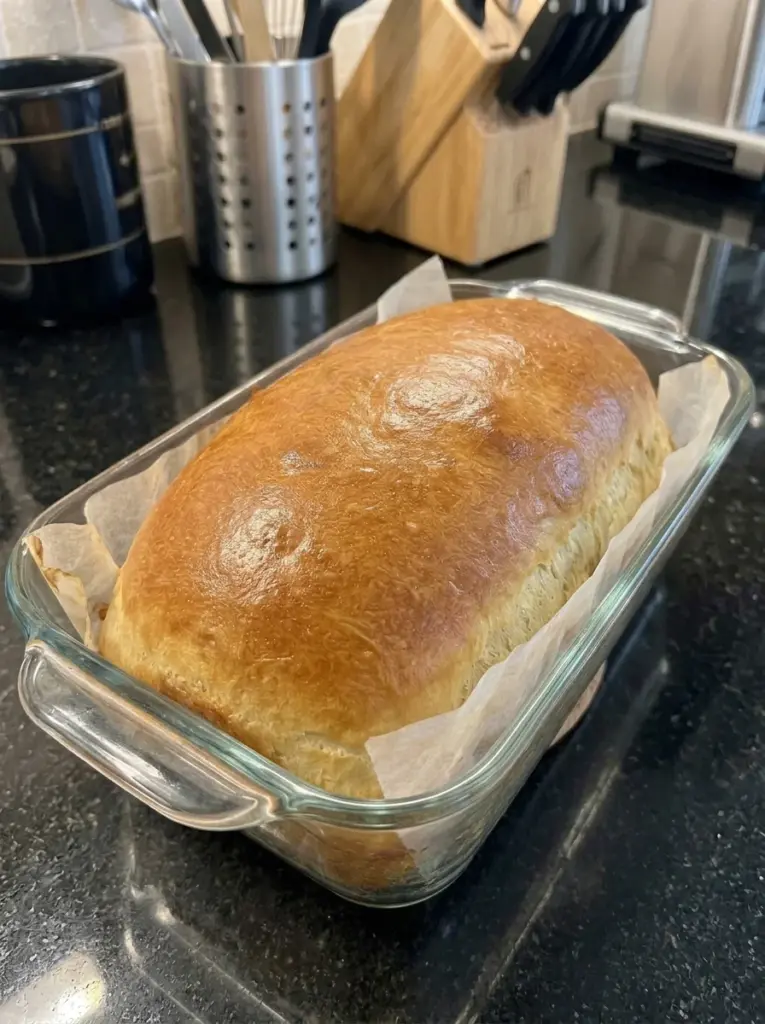
A soft milk sandwich loaf is useful long after the first buttered slice. Its tender crumb works for breakfast toast, packed sandwiches, and golden grilled cheese, while a lightly sweet flavor pairs with both savory fillings and fruit preserves.
This version uses milk, butter, and an egg to enrich a simple yeast dough. Kneading builds the structure, two rises give the dough time to expand, and a loaf pan supports an even sandwich shape. A small butter brushing after baking gives the crust a softer finish.
You can knead by hand or use a stand mixer fitted with a dough hook. Either way, follow how the dough feels and rises rather than adding flour until it becomes dry or trying to finish every stage at an exact minute.
Recipe at a Glance
- Preparation and kneading: About 25 minutes
- First rise: Approximately 60–90 minutes
- Second rise: Approximately 40–60 minutes
- Bake time: Approximately 30–40 minutes
- Cooling: About 1½–2 hours
- Total time: Approximately 4–5½ hours, including cooling
- Yield: One 9 × 5-inch loaf, about 12 slices
- Equipment: Large bowl, loaf pan, scraper, wire rack, and optional stand mixer
This suggested formula was developed from the dish title and has not been kitchen-tested. Ingredient temperature, flour, pan dimensions, and room conditions influence the result.
Why You’ll Love This Loaf
- A tender enriched crumb: Milk, egg, and butter give the loaf richness.
- A practical sandwich shape: The pan supports reasonably even slices.
- Mild sweetness: The loaf suits cheese, turkey, jam, or a simple butter spread.
- Two kneading options: Make the dough by hand or with a mixer.
- Freezer-friendly slices: Save part of the loaf before it loses freshness.
- A soft crust finish: Optional butter brushing makes the surface more tender.
What Is Milk Sandwich Bread?
Milk bread is a broad category of bread made with milk as part of its liquid. This recipe is a straightforward enriched sandwich loaf, without a cooked flour paste such as tangzhong or yudane.
Expect a soft, fairly close crumb rather than a crusty artisan loaf or a guarantee of the highly shreddable texture found in some specially developed milk breads. Good kneading and adequate proofing help the slices hold fillings without becoming overly dense.
Milk contributes flavor and helps the crust brown. Butter adds richness, while the egg contributes structure and moisture. Those ingredients also mean this dough may rise more slowly when refrigerator-cold ingredients are mixed in.
Ingredients
For the Dough
- 3¼ cups bread flour, spooned and leveled, plus a little more only if needed
- 1 cup whole milk, lukewarm
- 1 large egg, at room temperature
- 2 tablespoons granulated sugar
- 2¼ teaspoons instant yeast, one standard packet
- 1¼ teaspoons fine salt
- 3 tablespoons unsalted butter, softened
For the Pan and Finish
- A little butter or cooking spray, for greasing
- 1 tablespoon melted butter, optional, for brushing the baked loaf
Ingredient Notes
Bread flour: Bread flour provides structure for shaping and sandwich slices. All-purpose flour can be tried, but absorption and strength differ. Measure by spooning into the cup and leveling rather than packing it down.
Milk: Whole milk is the intended choice. Warm until lukewarm, around 90–100°F, or follow the yeast manufacturer’s directions. Very hot milk can harm yeast. Lower-fat milk changes richness but is generally closer to the base than a strongly flavored sweetened beverage.
Egg: Use one large egg for the intended moisture balance. An unusually small or large egg can affect how much adjustment the dough needs.
Instant yeast: Mix directly with the flour; a separate foaming step is not required. Use a fresh product stored as directed on the package.
Sugar: Two tablespoons give a gently sweet loaf. Large substitutions or reductions can change browning and flavor.
Butter: Softened butter should hold its shape but accept a fingertip indentation. Add after the dough comes together so it is easier to develop structure without starting with a greasy mixture.
Salt: Fine salt is specified. Coarse kosher salts vary considerably by spoonful, so they are not always equal-volume replacements.
How to Make a Milk Sandwich Loaf
1. Mix the Dough
Combine flour, yeast, sugar, and salt in a large bowl or mixer bowl. Whisk the milk and egg separately, then add to the dry ingredients.
Stir until no dry flour remains. Cover and rest for about 10 minutes to allow hydration. The dough should be soft and slightly tacky rather than stiff or pourable.
2. Add Butter and Knead
Work in the softened butter a little at a time. The dough may briefly smear or look uneven before it comes back together.
By hand, knead on a lightly floured surface for about 8–12 minutes after incorporating the butter, resting briefly if it resists stretching. With a mixer, use a low dough-kneading speed according to the manufacturer’s guidance, checking after about 6–8 minutes and continuing as needed.
The dough should become smoother and elastic. A small piece should stretch into a thin membrane before tearing, though it need not be perfectly transparent. Stop a mixer periodically to check the dough rather than assuming a timer guarantees development.
If the dough stays unusually wet after the rest and some kneading, add flour one tablespoon at a time. If genuinely dry and resistant, add milk one teaspoon at a time. Do not add flour simply to eliminate every trace of stickiness.
3. Complete the First Rise
Place in a lightly greased bowl and cover to prevent drying. Leave in mild warmth for approximately 60–90 minutes, until roughly doubled.
In a cool kitchen, the dough may take longer. Use expansion rather than the clock as the main cue, and avoid strong direct heat.
4. Prepare the Pan
Grease a 9 × 5-inch loaf pan. Turn the risen dough onto a lightly floured surface and gently press out large gas pockets.
Avoid working in a large amount of extra flour during shaping. A scraper can help move the dough while keeping the surface lightly dusted.
5. Shape the Loaf
Pat into a rectangle with its short side approximately as wide as the pan. Roll into a snug log, pressing the seam closed and tucking the ends underneath if needed.
Place seam-side down in the pan. The log should be reasonably even in thickness so the loaf rises more uniformly.
6. Allow the Final Rise
Cover loosely and let rise for about 40–60 minutes, until puffy and the center approaches or rises slightly above the pan rim. Pan dimensions and dough strength affect the exact height.
A gentle fingertip indentation should return slowly partway. Immediate recovery suggests more proofing time; a fragile surface that sinks suggests advanced proofing. Handle gently and bake promptly if the dough seems close to overproofing.
Meanwhile, preheat the oven to 350°F with a rack near the center.
7. Bake
Bake for approximately 30–40 minutes, checking toward the earlier end. The top should be golden and the center fully baked. Tent loosely with foil if the surface colors before the middle is ready.
An instant-read thermometer inserted into the center should read approximately 190–200°F as a useful doneness guide for this enriched loaf. Use temperature alongside its set structure rather than judging by crust color alone.
8. Finish and Cool
Brush the hot loaf with optional melted butter. Let rest in the pan for about 10 minutes, then turn out onto a wire rack.
Cool for about 1½–2 hours, or until no longer warm through the center. Slicing too early can compress the crumb and leave a gummy impression.
Use a serrated knife with a gentle sawing motion once cooled. Rewarm individual slices if you prefer warm bread.
Tips for Fluffy Sandwich Bread
Develop the dough before the first rise. A smooth, elastic dough holds gas more effectively than an uneven, barely mixed one.
Keep it soft. Too much flour is a common reason for a heavy loaf. Slight tackiness is expected.
Do not rush cool dough. Milk and egg enrich the dough but do not eliminate its need for adequate fermentation.
Shape evenly. A lopsided log can produce uneven height and large gaps in the crumb.
Watch the final proof. Both insufficient and excessive proofing affect oven expansion and structure.
Cool before sandwich slicing. The waiting time helps produce cleaner, sturdier slices.
Troubleshooting
| Problem | Possible cause | Helpful adjustment |
|---|---|---|
| Dough feels dry | Packed flour or small egg | Add milk in small increments during mixing. |
| Dough sticks excessively | Limited development or flour absorption differences | Rest and knead before adding flour gradually. |
| Rise is slow | Cool ingredients, room temperature, or weak yeast | Allow more time in mild warmth and check yeast freshness. |
| Loaf is dense | Excess flour, weak development, or insufficient proof | Keep the dough soft and assess both elasticity and expansion. |
| Top collapses | Overproofing or an unset center | Watch final proof and check baking doneness. |
| Crust browns quickly | Milk and sugar encouraging browning | Tent with foil while the center finishes. |
| Spiral gap inside loaf | Loose shaping or flour trapped between layers | Roll evenly and avoid heavy flour on the shaping surface. |
| Crumb seems gummy | Underbaking or early slicing | Check the center and cool fully. |
Variations
Sesame-Topped Loaf
Brush proofed dough lightly with a little milk and sprinkle with sesame seeds before baking. Apply gently to avoid deflating the loaf.
Herb Sandwich Bread
Add a small amount of dried thyme or rosemary with the flour. Keep the quantity modest so the bread remains suitable for different fillings.
Slightly Richer Serving
Keep the dough as written and serve slices with honey butter, jam, or cream cheese. Adding flavor at the table avoids changing the dough’s moisture balance.
Dinner Rolls
The dough can be divided into rolls, but pan arrangement, final proof, and bake time change. Begin checking much earlier than for a full loaf and verify the center rolls are baked through.
Whole-Wheat Experiment
A small partial substitution gives a heartier flavor and may change liquid needs. Replacing all the bread flour is not a direct equivalent and can reduce lightness.
Serving Suggestions
Use thin slices for turkey sandwiches or peanut butter and jam. Slightly thicker slices make a satisfying grilled cheese or breakfast toast.
Day-old bread can become French toast, bread pudding, or croutons. Its mild flavor works with both sweet and savory preparations.
For a fresh loaf, try a plain slice first before adding elaborate toppings. The milk and butter provide a gentle flavor that is pleasant on its own.
Make-Ahead, Storage, and Freezing
Bake and freeze slices for the most straightforward make-ahead option. Cool completely before putting the loaf in a bread bag or airtight container; warm bread releases moisture that can collect inside packaging.
Keep the plain loaf for about 2–3 days in a cool, dry kitchen. Freeze sooner if the kitchen is warm or humid or if you will not finish the bread promptly.
Refrigeration generally speeds staling, so freezing is more useful for longer storage. Wrap well and freeze for up to 3 months for best quality. Separate slices if you want easy individual portions.
Toast from frozen or thaw wrapped slices at room temperature. Warm only what you need to limit drying. Discard moldy bread rather than trimming away just the visible spot.
Prepared sandwiches require storage appropriate to their fillings, which may be more restrictive than the plain loaf guidance.
Frequently Asked Questions
Is this a no-knead recipe?
No. This version uses kneading to build structure. A no-knead formula needs its own handling and resting approach rather than simply skipping that step here.
Is this Japanese milk bread?
It is a simple milk-enriched sandwich loaf without tangzhong or yudane. Those techniques create different formulas and handling characteristics.
Can I use active dry yeast?
Follow the package directions for dissolving or adding it. Use some of the measured milk if a separate dissolving step is needed rather than adding extra liquid. Rising time may differ.
Can I use salted butter?
It adds salt to the formula. Reduce the measured salt according to your product and preference rather than assuming an identical balance.
Can I omit the egg?
The egg contributes moisture and structure. Removing it without adjusting the formula changes the dough. An egg-free milk bread recipe is a more predictable choice.
Why did the loaf not reach the pan rim?
Pan size, dough quantity, shaping, and proofing all matter. If the dough has barely expanded, allow more time. Do not wait for an exact height if it already looks fragile and overproofed.
Can I double the recipe?
Yes. Use two pans and divide the dough evenly. A mixer must be rated for the larger dough quantity. Baking time does not simply double, though oven circulation and browning may differ.
What is the calorie estimate?
Using typical ingredient values, the loaf may provide roughly 180–200 calories per twelfth, depending on flour measurement and whether finishing butter is included. Calculate from actual ingredients and slice size for greater precision.
Recipe Card
Fluffy Homemade Milk Sandwich Loaf
A tender yeast-raised milk bread with egg and butter, kneaded until elastic and baked in a loaf pan.
Prep and knead: 25 minutes | Rise: 1 hour 40 minutes–2½ hours | Bake: 30–40 minutes | Cool: 1½–2 hours
Total: Approximately 4–5½ hours | Yield: One 9 × 5-inch loaf, about 12 slices
Ingredients
- 3¼ cups bread flour, spooned and leveled
- 1 cup lukewarm whole milk
- 1 large egg, at room temperature
- 2 tablespoons sugar
- 2¼ teaspoons instant yeast
- 1¼ teaspoons fine salt
- 3 tablespoons softened unsalted butter
- Extra flour, only as needed for handling
- Butter or spray, for greasing
- 1 tablespoon melted butter, optional, for finishing
Instructions
- Combine flour, yeast, sugar, and salt. Whisk milk and egg separately, add, and mix until no dry flour remains. Rest 10 minutes.
- Incorporate softened butter gradually. Knead by hand for about 8–12 minutes or by mixer according to its guidance until smooth and elastic, allowing extra time as needed.
- Cover in a lightly greased bowl and rise for 60–90 minutes, until roughly doubled.
- Grease a 9 × 5-inch pan. Gently pat dough into a rectangle, roll into a log, seal the seam, and place seam-side down.
- Cover and proof for 40–60 minutes, until puffy and near or slightly above the rim. Preheat the oven to 350°F.
- Bake for 30–40 minutes, tenting if needed, until golden and set. Approximately 190–200°F at the center is a useful guide.
- Brush with optional butter, rest in the pan for 10 minutes, then cool fully on a rack before slicing.
Notes
- This suggested formula has not been kitchen-tested.
- Keep the dough soft and adjust flour or milk sparingly.
- Rising times are estimates; use visible expansion and dough behavior.
- Store fully cooled plain bread for about 2–3 days in a cool kitchen or freeze for up to 3 months for best quality.
- Approximate nutrition: 180–200 calories per twelfth, depending on ingredients and finishing butter. Calculate from your labels for precision.
Final Thoughts
A soft dough, thorough kneading, and patient proofing help this loaf develop its tender sandwich texture. Bake the center fully and allow enough cooling time for neat slices. Then keep it simple with toast, a favorite filling, or a little butter and jam.
Print
Fluffy Homemade Milk Sandwich Loaf
Ingredients
- 3¼ cups bread flour, spooned and leveled
- 1 cup lukewarm whole milk
- 1 large egg, at room temperature
- 2 tablespoons sugar
- 2¼ teaspoons instant yeast
- 1¼ teaspoons fine salt
- 3 tablespoons softened unsalted butter
- Extra flour, only as needed for handling
- Butter or spray, for greasing
- 1 tablespoon melted butter, optional, for finishing
Instructions
- Combine flour, yeast, sugar, and salt. Whisk milk and egg separately, add, and mix until no dry flour remains. Rest 10 minutes.
- Incorporate softened butter gradually. Knead by hand for about 8–12 minutes or by mixer according to its guidance until smooth and elastic, allowing extra time as needed.
- Cover in a lightly greased bowl and rise for 60–90 minutes, until roughly doubled.
- Grease a 9 × 5-inch pan. Gently pat dough into a rectangle, roll into a log, seal the seam, and place seam-side down.
- Cover and proof for 40–60 minutes, until puffy and near or slightly above the rim. Preheat the oven to 350°F.
- Bake for 30–40 minutes, tenting if needed, until golden and set. Approximately 190–200°F at the center is a useful guide.
- Brush with optional butter, rest in the pan for 10 minutes, then cool fully on a rack before slicing.