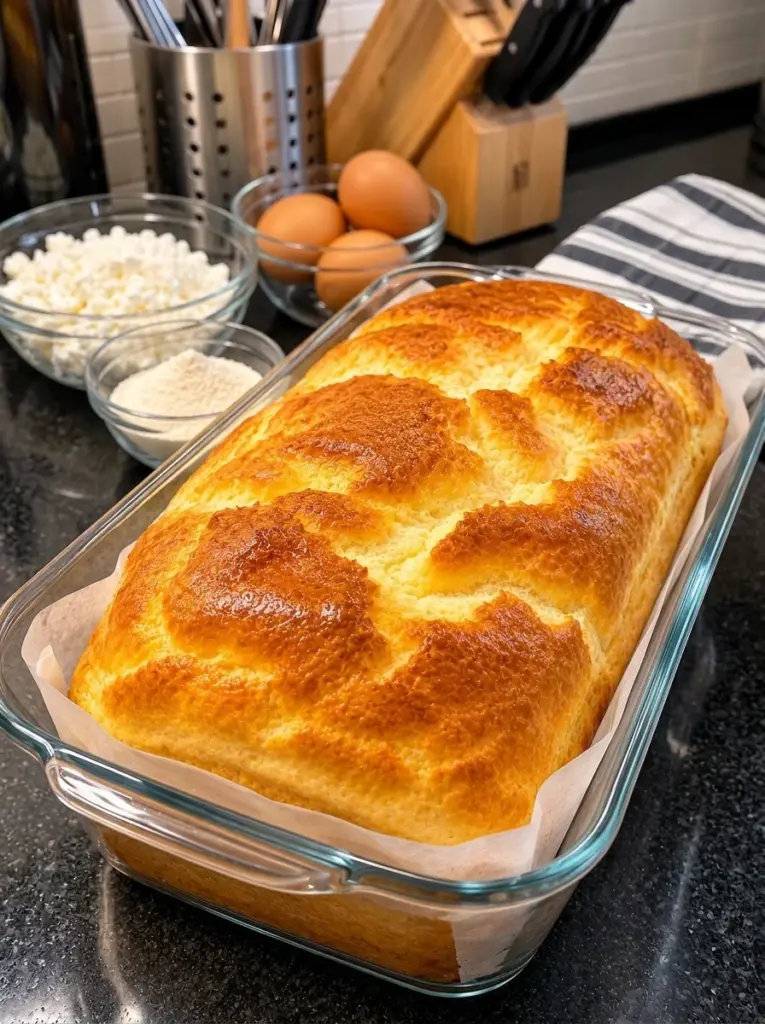
Cottage cheese cloud bread is an egg-based loaf with a light, sponge-like texture and a mild savory flavor. Whipped egg whites provide the lift, blended cottage cheese contributes moisture, and egg white protein powder adds concentrated protein and structure. There is no flour, yeast, or proofing stage.
This three-ingredient version is designed for thin slices that can be warmed gently, used for a small sandwich, or served beside breakfast. The texture is quite different from wheat bread: it is soft and springy, with an egg-forward character and a delicate browned exterior.
The method requires more care than a typical stir-together quick bread. Keeping the egg whites free from grease, incorporating the powder gradually, and folding without leaving heavy streaks all affect the final loaf. Cooling matters as well, because the center needs time to settle before slicing.
This article expands the supplied recipe. The formula has not been independently kitchen-tested, and the exact combination of cottage cheese and egg white powder may need adjustment after a trial bake. A tall loaf, uniform crumb, and minimal shrinkage cannot be guaranteed from the ingredient list alone.
What Is Cottage Cheese Cloud Bread?
Cloud bread is a family of egg-based breads whose lightness comes largely from whipped whites. Without wheat flour, the loaf does not develop the gluten network associated with conventional sandwich bread. Its structure instead depends on the egg proteins setting during baking.
Cottage cheese adds richness and moisture. Blending removes visible curds, but it does not eliminate the cheese’s water content. A particularly watery product can make this recipe harder to stabilize.
Egg white protein powder is the third structural ingredient. It is not interchangeable with vanilla protein powder, collagen, whey, or a plant protein blend. Products also differ from one another in concentration, additives, and how readily they disperse.
Expect a tender, airy, somewhat eggy loaf rather than a bakery sandwich bread. A little settling as it cools is normal for an egg foam. A severely collapsed loaf with a wet layer at the bottom suggests a problem with mixing, moisture, or baking.
Ingredients
Cloud Bread Batter
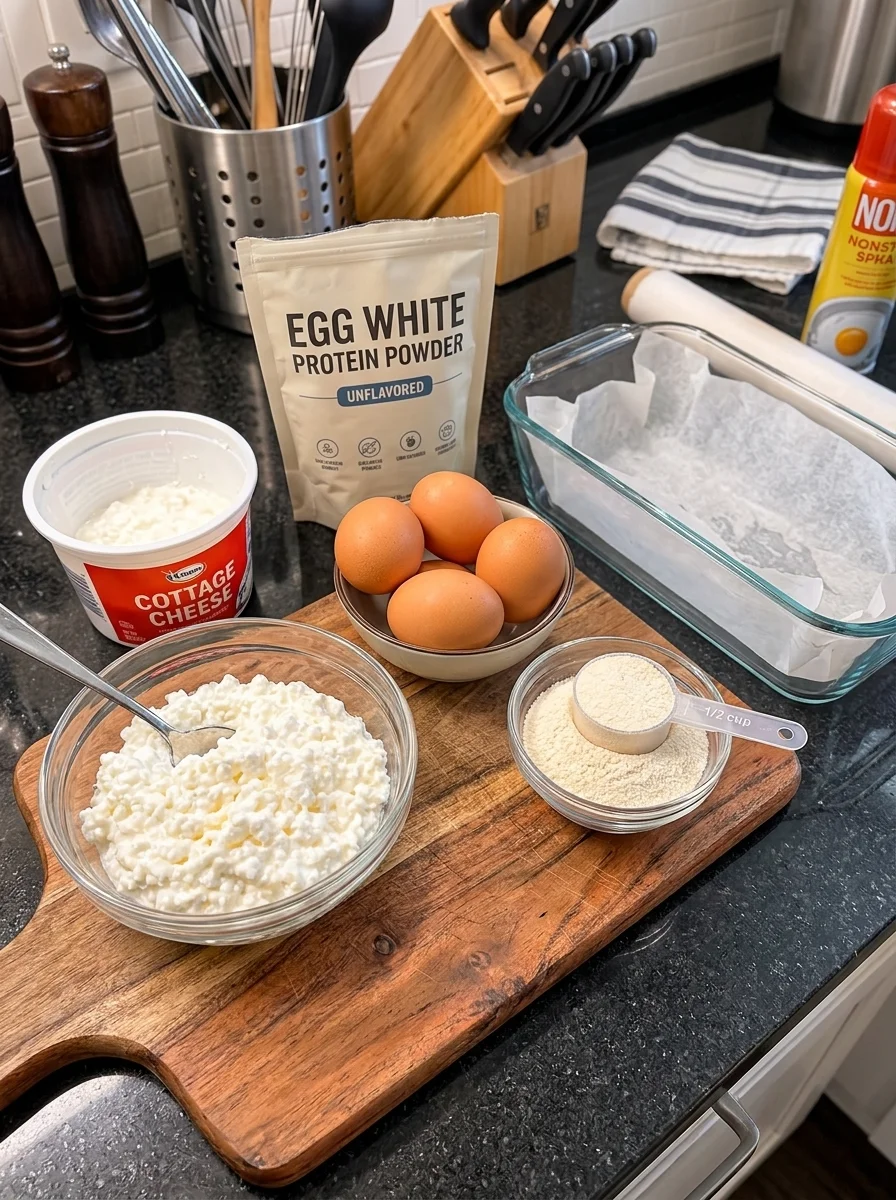
- 1 cup full-fat cottage cheese, approximately 8 ounces, with visible separated liquid drained away
- 4 large eggs, separated
- 1/2 cup unflavored egg white protein powder, approximately 1 1/2 ounces according to the supplied recipe; verify the weight against your product
Pan Preparation
- Parchment paper
- A little nonstick cooking spray or oil for exposed pan corners
Yield: One 9-by-5-inch loaf, approximately 10 slices, depending on the height achieved and how thickly it is cut.
The three-ingredient description refers to the batter. Pan spray is a preparation aid. There is no added baking powder, flour, sugar, or stabilizer in the base formula.
Choosing the Ingredients
Cottage cheese: consistency matters
Use plain full-fat cottage cheese with no sweet flavors or fruit. Pour off obvious surface whey before measuring. The cheese should still be moist and spoonable, not dried into a firm mass.
The listed cup is a household measure, and the approximate weight is only a guide. Different curd sizes and brands pack differently. For a repeatable trial, record both the product and the amount used.
Do not add water or milk to help the blender unless you are deliberately testing a new formula. Extra liquid changes a loaf whose structure already depends on a delicate balance between foam and a moist cheese mixture.
Low-fat cottage cheese may behave differently. It is not automatically a direct replacement with the same baking result. Begin with the supplied full-fat version before making substitutions.
Eggs: separate carefully
Separate the eggs without allowing yolk to enter the whites. A small bowl for each newly separated white helps prevent one broken yolk from contaminating the whole batch.
The whites can lose a little refrigerator chill while you prepare the other ingredients, but there is no need to leave eggs on the counter for an extended period. Keep the preparation moving and refrigerate ingredients if you need to pause.
Use clean beaters and a clean bowl. A trace of grease from cooking oil, butter, or a poorly washed utensil can interfere with foam development. Glass or stainless steel makes it easy to inspect the surface for residue.
Egg white powder: check the label
Use an unflavored product made primarily from egg whites. Read the ingredient list and preparation directions. Some products are intended for reconstitution, some are sold as protein supplements, and some contain additional ingredients.
Do not confuse egg white protein powder with meringue powder. Meringue powder may contain sugar, starch, flavorings, or other ingredients and is not an equal substitute.
The supplied volume and weight are approximate. A half cup may not weigh 1 1/2 ounces for every brand. If your product differs substantially, treat that as a reason for a small trial rather than assuming either measurement will behave identically.
This recipe uses the powder dry in an existing egg-white foam. That technique can be sensitive to the product. Powder that clumps, dries the foam, or causes it to lose volume may require a reformulated method rather than more beating.
Equipment
You will need a blender or food processor, an electric mixer, a large mixing bowl, a flexible spatula, a 9-by-5-inch loaf pan, parchment, and a wire rack. A thin-tip food thermometer is useful for checking the center.
Use a pan with enough headroom for expansion. A glass pan and a metal pan can produce different browning and heating patterns, so their baking times should not be assumed identical.
Line the bottom and two long sides with a parchment sling. Lightly grease any exposed corners to help release the loaf. Avoid a thick layer of oil, which is unnecessary and can smear into the foam during transfer.
How to Make the Loaf
1. Preheat and line the pan
Heat the oven to 325°F with a rack in the center. Prepare the parchment-lined loaf pan before beginning to whip the whites.
Once the foam is ready, it should not wait while you search for equipment or cut parchment. Organizing the pan and ingredients first makes the mixing stage easier to complete gently and promptly.
2. Blend the cottage cheese and yolks
Place the measured cottage cheese and four egg yolks in the blender. Blend for about 45–60 seconds, or until the mixture looks smooth, scraping down the sides as needed.
The goal is to remove visible curds and create an even mixture. Avoid adding liquid. If the blender struggles, stop and scrape rather than leaving it running continuously or thinning the cheese.
Set the mixture aside while you prepare the foam. Do not taste the raw yolk mixture.
3. Whip the egg whites to soft peaks
Place the four whites in the clean, grease-free bowl. Beat on medium speed until foamy, then increase to medium-high as the foam develops.
Stop at soft peaks: when the beaters are lifted, the foam should form a peak whose tip bends over. The supplied two-to-three-minute time is only a guide; mixer power and bowl shape affect the schedule.
Watch the foam rather than the clock. It should have fine bubbles and an even appearance, without a pool of clear white at the bottom.
4. Add the powder gradually
Reduce the mixer to low. Sprinkle in the egg white powder in small additions, allowing each to disperse before adding more. Avoid dumping it in a heap.
Continue beating only as needed to produce a stable foam that holds firm peaks. The mixture may not have the glossy appearance of a sweetened meringue because there is no sugar here.
Stop if it becomes dry, clumpy, or crumbly. More beating will not necessarily fix an overworked foam or a powder that does not disperse well. The supplied additional two-to-three-minute timing is not a requirement.
5. Fold the mixtures together
Stir a small scoop of the whipped whites into the cottage cheese mixture to lighten it. Then add that lightened mixture back to the remaining whites in two or three portions.
Use a spatula to cut down through the center, sweep along the bottom, and lift the mixture over itself. Rotate the bowl between folds.
Fold until the color is reasonably uniform and there are no obvious pockets of dense cheese mixture at the bottom. Do not limit yourself to a fixed three or four strokes: too few can leave heavy streaks, while vigorous stirring deflates the foam. Use enough gentle folds to combine the batter.
6. Transfer without packing
Spoon the batter into the prepared pan. Spread it gently into the corners and level the top without pressing it down.
Do not bang the pan hard against the counter. The trapped air is the loaf’s main source of lift. A few large surface irregularities are less important than preserving the foam.
Bake promptly after mixing.
7. Bake until the center sets
Bake at 325°F, starting to check at about 40 minutes. The supplied 40–45-minute window is a starting point; the loaf may require longer depending on the pan, ingredients, and oven.
Look for a browned top and a center that feels set rather than liquid or sloshy. Check the middle with a thermometer: egg dishes should reach at least 160°F. Reaching that safety temperature does not guarantee the ideal bread texture, so the center also needs to look and feel baked.
If the top darkens before the middle is ready, loosely shield it with foil and continue baking. Avoid opening the oven repeatedly during the early part of the bake.
8. Cool gradually
Once the loaf is baked, switch the oven off. If your oven’s instructions permit cooling with the door slightly open, let the loaf stand inside for about ten minutes with the door ajar. Otherwise, remove it and allow it to settle in the pan on a heat-safe surface.
Do not wedge the door open with a wooden spoon unless the appliance manufacturer specifically permits that practice. Gradual cooling may reduce abrupt settling, but it cannot prevent collapse caused by an underbaked or poorly mixed center.
9. Finish cooling and slice
Let the loaf stand in the pan for about ten minutes after removing it from the oven. Lift using the parchment sling and transfer carefully to a wire rack.
Cool completely before slicing, allowing approximately 45–60 minutes or longer if the center remains warm. Use a serrated knife with gentle strokes rather than pressing straight down.
The exact cooling schedule can vary, but refrigerate promptly within the safe limits discussed below. Do not leave an egg-and-dairy loaf out all day while waiting for its texture to improve.
Texture Tips
A stable foam starts with clean equipment and careful egg separation. If yolk enters the whites, starting over with clean whites may be more effective than trying to beat through the contamination.
Moisture control starts with the cheese. Drain visible whey before measuring, but do not turn the cottage cheese into a dry paste. Record the consistency of a successful batch so you can repeat it.
Fold enough to combine the mixtures. Distinct yellow streaks can sink and form a dense layer, even if the top looks beautifully airy. A uniform batter should still retain visible volume.
Do not expect the loaf to remain exactly as tall as it appears in the hot oven. Some shrinkage is normal. The more useful checks are whether it slices, whether the crumb is set, and whether there is a wet layer underneath.
Toasting and Serving
Cloud bread can be delicate in a pop-up toaster, especially in thin slices. A toaster oven or dry skillet gives you more control and makes it easier to support the slice.
Warm gently until the edges become lightly crisp. Watch closely because an egg-based slice can brown quickly and may not behave like ordinary toast.
For breakfast, serve with eggs, avocado, or a little cream cheese. For a sandwich, use a modest amount of filling and avoid very wet sauces that can overwhelm the soft structure.
For a snack, try a small amount of nut butter or a savory spread. Toppings can change carbohydrate and calorie totals substantially, so include them when calculating a meal.
Storage and Food Safety
This moist egg-and-dairy loaf should be refrigerated. The supplied suggestion to keep slices at room temperature for a full day is not appropriate as a general storage instruction for an unvalidated recipe of this type.
Cool promptly and refrigerate in a covered container at 40°F or below. Use within three to four days, subject to ingredient freshness and proper handling. A dry paper towel can absorb condensation, but it does not extend the safe storage period.
Do not leave the loaf or slices at room temperature for more than two hours, or more than one hour when the surroundings exceed 90°F. Follow USDA leftover handling guidance.
For reheated leftovers, heat the center to 165°F according to USDA reheating guidance. Use an oven or skillet if a fragile slice would be difficult to retrieve from a toaster.
Store sandwich fillings separately when possible and assemble close to eating. Keep packed portions chilled with ice packs.
Freezing
Slice only after the loaf has cooled and the crumb has set. Place parchment between slices and pack in a freezer-safe bag or container with excess air removed.
Freeze for up to two months for best quality. This is a quality guideline, not a guarantee that the texture will be unchanged. An egg foam can become softer or release moisture after thawing.
Thaw in the refrigerator rather than leaving the entire loaf on the counter. Warm slices gently in a skillet or toaster oven. Heating directly from frozen may also work, but allow enough time for the center to warm thoroughly without burning the edges.
Freeze individual portions so you do not need to thaw and refreeze the whole batch.
Nutrition and the Keto Description
With no flour or added sugar, the batter is likely to be relatively low in carbohydrates compared with conventional wheat bread. It is not carbohydrate-free: cottage cheese contributes lactose, and some powders contain additional carbohydrates.
Whether a serving fits a keto eating plan depends on your product labels, slice size, toppings, and overall intake. The recipe title is descriptive, not a verified nutrition-label claim.
For an illustrative calculation, cottage cheese may contribute about 24–28 grams protein, four eggs about 24–28 grams, and 1 1/2 ounces of egg white powder roughly 30–36 grams, depending on the product. That places the batch around 78–92 grams protein, or approximately 8–9 grams per ten-way slice.
Calories may fall roughly around 70–85 per slice, with carbohydrates often around 1–2 grams, but these are broad estimates rather than a calculated panel. Weigh the actual powder and use all three package labels for a more useful result. Uneven or thicker slices change the per-serving numbers.
Troubleshooting
The loaf collapsed dramatically
Possible causes include an underbaked center, a deflated foam, excess moisture, or incomplete mixing that left a heavy layer. A gradual cool alone will not correct those issues. Check your ingredient measurements and bake the center fully on the next trial.
There is a dense layer at the bottom
The cottage cheese mixture may have been insufficiently folded into the whites or too watery. Scrape the bottom during folding and look for a reasonably uniform color before transferring to the pan.
The whites will not whip
Check for yolk, grease, or a dirty bowl. Confirm that you are using actual egg whites rather than a whole-egg product. Do not add the dense cottage cheese mixture before the foam is ready.
The powder made the whites clumpy
It may have been added too fast, may not disperse readily, or may be unsuitable for this method. Add gradually and avoid excessive beating. A different product may require a different formula; do not assume all protein powders are interchangeable.
The bread tastes eggy
Eggs are a major ingredient, so some egg flavor is expected. Cooling fully and warming gently before serving may make it more pleasant, but the loaf will not taste like a neutral wheat bread.
The center seems wet after slicing
Allow the loaf to cool completely before judging. If it is still paste-like or releases liquid, it may be underbaked or contain too much moisture. Do not interpret a browned top as proof that the center is finished.
Frequently Asked Questions
Can I use whey protein powder?
No direct substitution is recommended. Whey, collagen, and plant protein powders do not have the same foaming and setting behavior as egg white powder.
Can I skip the powder?
That would create a different formula with less dry structure. It needs its own testing rather than simply using the same pan and baking time.
Can I add baking powder?
The supplied formula relies on egg foam. Adding leavening changes the recipe and may not solve a structural problem. First assess the whipping, folding, moisture, and doneness.
Can I make rolls instead?
Portioning into smaller shapes changes how the foam spreads and sets. That variation may be worth testing, but the loaf timing should not be applied to small portions.
Is it gluten-free?
The three main ingredients do not inherently require wheat, but check the powder label and cross-contact information if gluten avoidance is medically important. Use appropriately labeled products and clean equipment.
Print
Keto 3-Ingredient Cottage Cheese Cloud Bread
Description
- Prep: Approximately 20 minutes
- Bake: Start checking at 40–45 minutes; allow longer if needed
- Gradual cooling and pan rest: About 20 minutes
- Rack cooling: About 45–60 minutes, until fully cool
- Total: Approximately 2 hours 5 minutes to 2 hours 25 minutes, potentially longer if baking requires it
- Yield: One 9-by-5-inch loaf, approximately 10 slices
Ingredients
Cloud Bread Batter
- 1 cup full-fat cottage cheese, approximately 8 ounces, with visible separated liquid drained away
- 4 large eggs, separated
- 1/2 cup unflavored egg white protein powder, approximately 1 1/2 ounces according to the supplied recipe; verify the weight against your product
Pan Preparation
- Parchment paper
- A little nonstick cooking spray or oil for exposed pan corners
Yield: One 9-by-5-inch loaf, approximately 10 slices, depending on the height achieved and how thickly it is cut.
The three-ingredient description refers to the batter. Pan spray is a preparation aid. There is no added baking powder, flour, sugar, or stabilizer in the base formula.
Instructions
1. Preheat and line the pan
Heat the oven to 325°F with a rack in the center. Prepare the parchment-lined loaf pan before beginning to whip the whites.
Once the foam is ready, it should not wait while you search for equipment or cut parchment. Organizing the pan and ingredients first makes the mixing stage easier to complete gently and promptly.
2. Blend the cottage cheese and yolks
Place the measured cottage cheese and four egg yolks in the blender. Blend for about 45–60 seconds, or until the mixture looks smooth, scraping down the sides as needed.
The goal is to remove visible curds and create an even mixture. Avoid adding liquid. If the blender struggles, stop and scrape rather than leaving it running continuously or thinning the cheese.
Set the mixture aside while you prepare the foam. Do not taste the raw yolk mixture.
3. Whip the egg whites to soft peaks
Place the four whites in the clean, grease-free bowl. Beat on medium speed until foamy, then increase to medium-high as the foam develops.
Stop at soft peaks: when the beaters are lifted, the foam should form a peak whose tip bends over. The supplied two-to-three-minute time is only a guide; mixer power and bowl shape affect the schedule.
Watch the foam rather than the clock. It should have fine bubbles and an even appearance, without a pool of clear white at the bottom.
4. Add the powder gradually
Reduce the mixer to low. Sprinkle in the egg white powder in small additions, allowing each to disperse before adding more. Avoid dumping it in a heap.
Continue beating only as needed to produce a stable foam that holds firm peaks. The mixture may not have the glossy appearance of a sweetened meringue because there is no sugar here.
Stop if it becomes dry, clumpy, or crumbly. More beating will not necessarily fix an overworked foam or a powder that does not disperse well. The supplied additional two-to-three-minute timing is not a requirement.
5. Fold the mixtures together
Stir a small scoop of the whipped whites into the cottage cheese mixture to lighten it. Then add that lightened mixture back to the remaining whites in two or three portions.
Use a spatula to cut down through the center, sweep along the bottom, and lift the mixture over itself. Rotate the bowl between folds.
Fold until the color is reasonably uniform and there are no obvious pockets of dense cheese mixture at the bottom. Do not limit yourself to a fixed three or four strokes: too few can leave heavy streaks, while vigorous stirring deflates the foam. Use enough gentle folds to combine the batter.
6. Transfer without packing
Spoon the batter into the prepared pan. Spread it gently into the corners and level the top without pressing it down.
Do not bang the pan hard against the counter. The trapped air is the loaf’s main source of lift. A few large surface irregularities are less important than preserving the foam.
Bake promptly after mixing.
7. Bake until the center sets
Bake at 325°F, starting to check at about 40 minutes. The supplied 40–45-minute window is a starting point; the loaf may require longer depending on the pan, ingredients, and oven.
Look for a browned top and a center that feels set rather than liquid or sloshy. Check the middle with a thermometer: egg dishes should reach at least 160°F. Reaching that safety temperature does not guarantee the ideal bread texture, so the center also needs to look and feel baked.
If the top darkens before the middle is ready, loosely shield it with foil and continue baking. Avoid opening the oven repeatedly during the early part of the bake.
8. Cool gradually
Once the loaf is baked, switch the oven off. If your oven’s instructions permit cooling with the door slightly open, let the loaf stand inside for about ten minutes with the door ajar. Otherwise, remove it and allow it to settle in the pan on a heat-safe surface.
Do not wedge the door open with a wooden spoon unless the appliance manufacturer specifically permits that practice. Gradual cooling may reduce abrupt settling, but it cannot prevent collapse caused by an underbaked or poorly mixed center.
9. Finish cooling and slice
Let the loaf stand in the pan for about ten minutes after removing it from the oven. Lift using the parchment sling and transfer carefully to a wire rack.
Cool completely before slicing, allowing approximately 45–60 minutes or longer if the center remains warm. Use a serrated knife with gentle strokes rather than pressing straight down.
The exact cooling schedule can vary, but refrigerate promptly within the safe limits discussed below. Do not leave an egg-and-dairy loaf out all day while waiting for its texture to improve.